English
 Español
What Is a DC MCB and Why Does It Matter for Solar PV Systems?
A commercial solar installer in Texas called about a recurring problem. Every few months, a combiner box would smoke. The breakers inside were standard residential AC units. The installer had assumed that any breaker would work. After the third failure, the utility required a full inspection. The cause was DC arcing. The AC breakers could not interrupt the DC current, and the contacts welded shut. The replacement was a DC MCB for solar — a miniature circuit breaker designed for photovoltaic strings, with extended contact gaps and magnetic blowout arc extinguishing.
A DC MCB for solar is a protective device installed on the DC side of a photovoltaic system. It interrupts overcurrents and short circuits in the DC circuit, preventing damage to modules, cables, and inverters. Unlike a fuse, which must be replaced after operation, a DC MCB can be reset. This article explains what a DC MCB does, how it differs from an AC breaker, why the 1000V rating matters for modern solar arrays, and how to select the right current rating — without comparing specific brands or models.
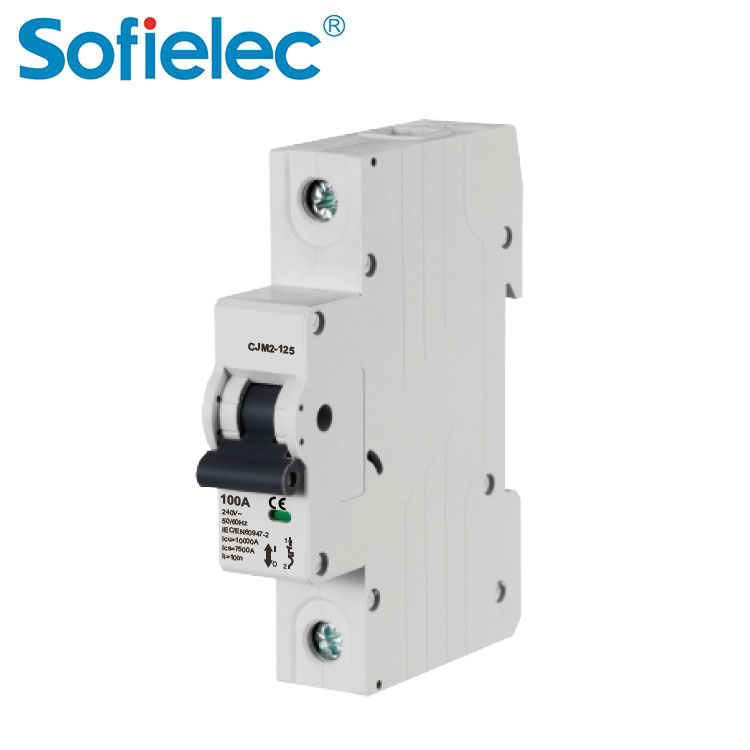
Inside the combiner box: protecting each string from overcurrent
In a photovoltaic system, strings of modules feed DC power into a combiner box, which then routes current to an inverter. A DC MCB for solar is placed on each string output, before the common bus. Its job is twofold: protect against sustained overcurrents (thermal trip) and against short circuits (magnetic trip).
Thermal protection uses a bimetal strip. When the current exceeds the rated value for a period, the strip heats up and bends, tripping the mechanism. For a 125A breaker, a 150A overload may trip in tens of seconds; a 200A overload in seconds.
Magnetic protection uses a solenoid. When a short circuit occurs — current may rise to thousands of amps — the magnetic field pulls the armature instantly, tripping the breaker in milliseconds.
The number of poles determines how the breaker is wired. A 1‑pole DC MCB (like the product in this guide) protects one conductor — typically the positive lead in a grounded system where the negative is bonded to ground. A 2‑pole breaker protects both positive and negative in floating (ungrounded) systems. A 4‑pole breaker can handle two independent DC strings or serve as a multi‑pole disconnect for large combiner boxes.
The CJM2-125 is rated 125A, with a breaking capacity of 10kA at 1000V DC. For a typical 500W module with Isc around 15A, a string of 6 modules stays well under 125A. The 10kA breaking capacity ensures that even a catastrophic short from a large battery bank or multiple strings in parallel is safely interrupted.
Why an AC breaker can’t handle DC – a technical comparison
AC current drops to zero 100 or 120 times per second. When an AC breaker opens, the arc extinguishes naturally at the next zero crossing. DC current never drops to zero. The arc that forms between the contacts can sustain itself, burning through the contact surfaces and often welding them shut.
| Feature | AC MCB | DC MCB |
|---|---|---|
| Arc extinguishing | Natural at zero crossing | Magnetic blowout with extended arc chute |
| Contact gap | Smaller (2‑3mm typical) | Larger (4‑8mm) |
| Arc chute | Standard | Deep arc chute with splitter plates |
| Typical voltage rating | 120/240V AC | Up to 1000V DC |
| Magnetic blowout | Not required | Permanent magnet or solenoid |
A DC MCB for solar addresses the DC arc problem with three design features. First, the contact gap is larger, so the arc has to stretch further before it can extinguish. Second, a magnetic blowout magnet or coil pushes the arc sideways into an arc chute. The chute splits the arc into multiple small arcs, each of which extinguishes more quickly. Third, the arc chute has more plates than an AC equivalent, dissipating arc energy faster.
Using an AC MCB in a DC circuit is dangerous. The small contact gap may not interrupt the DC arc, the arc chute may be insufficient, and the contacts can weld closed. In a PV system, a welded contact means the string cannot be disconnected, creating a fire hazard during maintenance. The CJM2-125 series is specifically rated for 1000V DC, with a breaking capacity of 10kA at that voltage.
Why today’s solar strings need 1000V‑rated protection
Solar string voltages have increased over the years. A decade ago, 600V DC was standard. Today, 1000V DC is common for commercial and utility‑scale systems. The latest trend is 1500V DC for large ground‑mount arrays.
A DC MCB for solar rated for 1000V DC can be used on both 600V and 1000V systems. If the system is upgraded from 600V to 1000V, the breaker does not need replacement. For a 1500V system, a 1500V‑rated breaker is required.
The 1000V rating influences the contact gap and arc chute design. A breaker rated for 1000V has a larger contact gap than a 600V breaker, requiring more force to open. The magnetic blowout is stronger, and the arc chute has more plates. A 1000V DC breaker is physically larger than a 600V DC breaker of the same current rating.
The CJM2-125 series is rated 1000V DC with a 10kA breaking capacity. This covers most commercial rooftop and ground‑mount arrays where string voltages are 800‑1000V DC. For a 1500V system, a different series would be required.
Where the breaker belongs in the circuit – The DC MCB is installed on each string output, inside the combiner box or on the roof next to the array. Some inverters have integrated DC breakers, but for multi‑string systems, individual string protection is required by code (NEC 2020 requires rapid shutdown and string‑level disconnecting means).
What installers and designers often ask about DC string protection
Question 1: Can I use a regular AC MCB for my DC solar circuit?
No. AC MCBs are not designed to interrupt DC arcs. Using one in a DC circuit can result in contact welding, fire, or inability to disconnect the string under load. The NFPA 70 (NEC) and IEC 60947-2 standards require DC‑rated breakers for photovoltaic systems.
Question 2: What’s the difference between a DC MCB and a DC fuse?
A fuse is a one‑time device. When it operates, it must be replaced. A DC MCB can be reset, reducing maintenance downtime and spare parts inventory. Fuses may have lower let‑through energy for very high short circuits, but DC MCBs offer the advantage of reusable protection and more precise overload curves. For string protection in a combiner box, a DC MCB is common; for main array protection, a fused disconnect may be used.
Question 3: How do I select the right current rating for a DC string?
A DC MCB for solar should be sized at 125% of the maximum string current (Isc × number of parallel strings). For a single string with Isc = 15A, the breaker rating should be at least 18.75A, so a 20A breaker is appropriate. The CJM2-125 series ranges from low currents up to 125A. Oversizing the breaker — using a 125A breaker on a 20A string — may not provide overload protection because the thermal trip will take too long at low overcurrents. Match the rating to the actual string current.
Question 4: Do I need a DC MCB on both positive and negative poles?
For a floating (ungrounded) system, both poles should be interrupted, requiring a 2‑pole breaker or two 1‑pole breakers ganged together. For a grounded system where the negative is bonded to earth, only the ungrounded pole (positive) needs protection. Check local electrical codes; NEC 2020 allows single‑pole switching for grounded systems, but some jurisdictions require double‑pole.
Question 5: What approvals should a DC MCB have for US projects?
For US installations, look for UL 489 for DC (branch circuit protection) or UL 1077 (supplementary protection). UL 489 is required for branch circuit protection in most commercial applications. The CJM2-125 series carries CE marking; for UL‑listed versions, verify with the supplier.
Question 6: How does the C‑curve (C32) affect the breaker’s performance?
The C32 designation indicates a C‑curve trip characteristic (magnetic trip between 5‑10 times rated current) and 32A rating for that specific variant (though the product name shows 125A; check the actual rating). C‑curve is suitable for general loads with moderate inrush currents, such as string inverters and combiner box feeders.
Putting it all together: selecting the right DC breaker for your array
Before finalizing a DC MCB specification, review these parameters:
-
System voltage – 600V, 1000V, or 1500V? Select a breaker rated for at least the maximum string voltage.
-
String current (Isc) – Multiply Isc by 1.25. The breaker should be sized at or above this value, but not excessively higher.
-
Number of poles – 1‑pole for grounded systems, 2‑pole for floating systems, 4‑pole for dual strings or large combiner boxes.
-
Breaking capacity – Must exceed the available fault current at the installation point. A 10kA rating is typical for string protection in commercial arrays.
-
Approvals – UL 489 for branch circuit protection, CE for European markets.
A DC MCB for solar that is correctly sized and rated will provide years of reliable protection. For large‑scale projects, request sample breakers for qualification testing. Verify the breaking capacity with a short‑circuit study. Confirm that the trip curve matches the upstream and downstream protection devices for coordination.
Sofielec manufactures the CJM2-125 series DC miniature circuit breaker, rated 1000V DC with a 10kA breaking capacity. The 1‑pole unit (product in this guide) is suitable for grounded PV systems where only the positive conductor requires protection. The breaker features thermal and magnetic protection, a compact DIN rail form factor, and C‑curve trip characteristics.
【Request a quote from Sofielec】
Contact Sofielec with your system voltage, string Isc value, and mounting configuration to receive a DC MCB recommendation and a sample for testing in your combiner box.