English
 Español

Can an Isolating Switch Break a 150A Load?
An Isolating Switch that lives outdoors or in a washdown area has to do two things at once: keep moisture and dust out of the contact chamber, and stay operable when someone needs to isolate a circuit in a hurry. You'll see how the IP65 PC enclosure handles the first job, how the rotary mechanism handles the second, and where the 4P 150A envelope fits.
What Questions Come Up Before Mounting a Rotary Isolator Outdoors?
What does IP65 actually protect on a rotary switch?
IP65 covers two ingress paths: dust-tightness (the 6) and protection against water jets from any direction (the 5). On a rotary isolator, the enclosure has to protect both the contact chamber and the shaft seal where the handle passes through the cover. The page lists IP65 for the 4P 150A model in a PC plastic enclosure. That's the rating that matters when the switch is mounted on an outdoor panel, a washdown skid, or a piece of equipment that gets hosed down during cleaning.
Does the enclosure material affect the switching rating?
The enclosure doesn't change the electrical rating, but it determines how long that rating holds in a wet environment. The page specifies a PC (polycarbonate) plastic enclosure. PC is chosen for impact resistance and dimensional stability—it doesn't swell or soften like some thermoplastics when exposed to moisture. The electrical rating is 4P 150A at AC 230/400V, 50/60Hz; the PC housing is what keeps the internal contacts and mechanism isolated from the environment that rating was tested in.
The Rotary Mechanism and Load Operation
The page states the switch provides switching capacity with load operation. That phrase is the functional distinction between an isolator and a mere disconnector: a load-break isolator can open a circuit that's carrying current, not just a circuit that's already been de-energized.
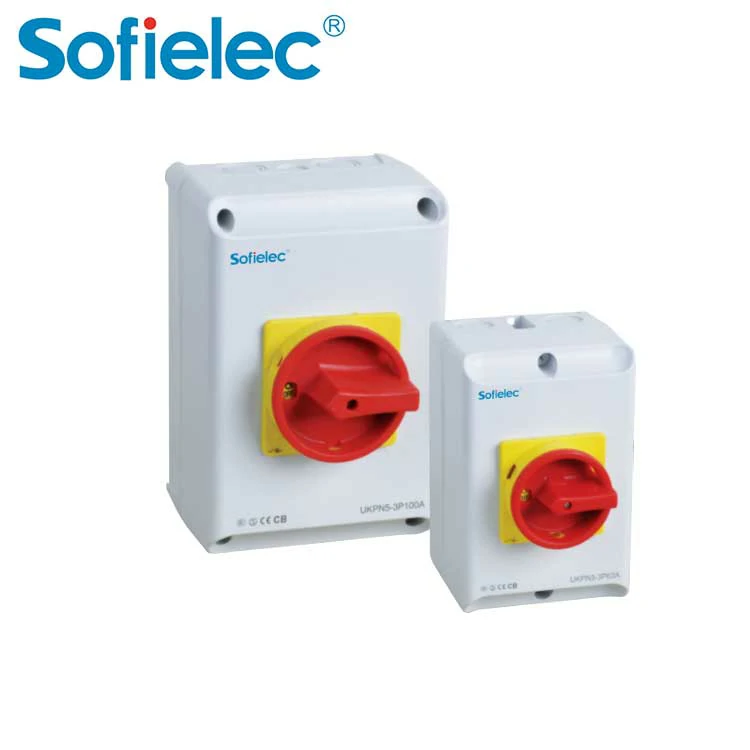
Industry-standard rotary isolators achieve that load-breaking capability through a spring-assisted mechanism: a spiral transmission drives the moving contact, and a scroll spring stores energy during the handle rotation, releasing it to snap the contacts open or closed at speed. That snap action is what suppresses the arc at 150A—if the contacts parted slowly, the arc would linger and erode the contact surfaces. The rotary handle gives the operator a mechanical advantage and a clear ON/OFF position, and the page notes a color signal indication window for contact position state.
Why the position window matters on a sealed enclosure
When the contact chamber is sealed behind an IP65 cover, the operator can't see the contacts directly. The color signal indication window is the visual confirmation that the switch is open or closed. Without it, a sealed isolator would require a separate voltage test to confirm isolation—which defeats the purpose of a quick, visible disconnect.
Pole Configuration and the 4P 150A Envelope
The 4P format switches three phases plus neutral, which is the configuration for a three-phase circuit that needs the neutral isolated along with the phases. The page lists 3- and 4-pole options; the 4P version is the one that suits a distribution circuit where the neutral is part of the isolation boundary.
| Parameter | SOFielec IP65 rotary isolator (4P 150A) |
|---|---|
| Pole configuration | 4P (3P+N) |
| Rated current | 150A |
| Rated voltage | AC 230/400V |
| Rated frequency | 50/60Hz |
| Protection degree | IP65 |
| Enclosure material | PC plastic |
| Size range | 160–280mm |
| Switching capability | Load operation (load-break) |
| Position indication | Color signal window |
| Mounting | Panel / enclosure mount |
The 150A rating puts this switch at the upper end of the compact rotary isolator class. It's sized for a feeder or a sub-main, not a small final circuit—a 150A load-break device is the main disconnect for a machine, a distribution board, or a skid-mounted equipment package.
What the 230/400V rating covers
The dual voltage rating reflects the two ways a three-phase system is measured: 230V phase-to-neutral and 400V phase-to-phase. A 4P switch at this rating can isolate a 400V three-phase circuit while also breaking the 230V neutral. That's the configuration a European or IEC-based installation expects for a main switch on equipment that requires full isolation.
Where the Load-Break Function Fits the Circuit
A non-load-break disconnector can only be operated after the downstream load is switched off by some other device. A load-break isolator can open the circuit itself, which makes it the first device an operator reaches for when something needs to be isolated quickly.
-
Machine main switch: isolates the entire equipment package at the end of a shift or before maintenance
-
Distribution sub-main: provides a local disconnect for a feeder that feeds a panel or a skid
-
Motor circuit isolation: opens a 150A motor branch without requiring the contactor to open first
-
Outdoor equipment: the IP65 enclosure allows the isolator to be mounted on the equipment rather than inside a separate weatherproof cabinet
What to check before specifying a 4P 150A unit
Confirm the circuit current against the 150A rating, the pole configuration against the neutral isolation requirement, and the enclosure rating against the installation environment. The IP65 rating covers water jets and dust, but the mounting location still determines whether the enclosure faces direct sun, chemical splash, or physical impact. A PC enclosure handles UV and impact better than a generic plastic, but the site conditions are the deciding factor for the mounting method and any additional shield.
Where the SOFielec Rotary Isolator Fits the Installation
The IP65 rotary isolator switch with PC plastic enclosure from SOFielec is built around the load-break, weather-sealed role described on the page: 4P 150A at AC 230/400V, IP65 protection, PC housing, load-operation switching, and a color position indication window. The 160–280mm size range and panel-mount format place it in the equipment-mounted tier rather than the DIN-rail miniature tier. For an Isolating Switch application where the disconnect point sits on the machine or on an outdoor skid, the value sits in the sealed enclosure and the load-break mechanism—the switch can be operated under load without opening a separate enclosure, and the position window gives a visual confirmation that the circuit is isolated.
[H3] What to confirm before committing to a quantity
Confirm the current and voltage against the circuit, the pole count against the neutral requirement, and the IP65 rating against the cleaning and weather exposure at the mounting location. The page's 4P 150A envelope and PC enclosure give the starting point; the installation drawing determines the mounting arrangement and whether a 3P or 4P configuration is the right fit.
[H2] Let's Match an Isolator to Your Disconnect Point
Send over your circuit current, voltage, pole requirement, and mounting environment—we'll help you check them against the SOFielec IP65 rotary isolator's 4P 150A rating, PC enclosure, and load-break capability. Talk to SOFielec about your Isolating Switch requirements and get a specification-level answer before you commit to the disconnect.