English
 Español

Can SPD Surge Protective Device Prevent Fires?
Yes—when the SPD Surge Protective Device is paired with a dedicated backup protector that disconnects the SPD at end-of-life before the metal oxide varistors overheat. A 50kA/100kA single-phase SPD handles the surge energy, and the XZSCB backup protector closes the fire-safety gap that a generic fuse or breaker leaves. This article explains what the In and Imax ratings actually mean, why the backup protector matters as much as the SPD itself, and what to verify when you're specifying surge protection for a residential or light commercial panel.
What Do the 50kA and 100kA Ratings Actually Mean?
Nominal Discharge vs. Maximum Discharge
The nominal discharge current (In) is the 8/20μs current the device can handle repeatedly without degrading its protective function. The maximum discharge current (Imax) is the peak current it can survive in a single event.
A device rated 50kA In and 100kA Imax is built for a location where the expected surge environment is moderate—typically a residential or light commercial panel that is not directly exposed to the highest-energy strikes. The 50kA In rating means the device can absorb multiple surge events over its service life, while the 100kA Imax rating provides a one-time margin for a more severe event.
Why the Higher 100kA In Rating Matters
A 100kA In device is specified where the surge exposure is higher—a building with a large rooftop array, a facility near a transformer, or an installation with long outdoor cable runs. The higher In rating means the device can handle more repeated surge events before the metal oxide varistors degrade.
The XZSCB series from Sofielec covers both the 50kA In and 100kA In classes in the same product family, so the specifier can match the device to the exposure level without switching to a different platform.
| Parameter | 50kA Class | 100kA Class |
|---|---|---|
| Nominal discharge (In) | 50kA | 100kA |
| Maximum discharge (Imax) | 100kA | 120kA / 150kA |
| Rated operating voltage | 230V/400V AC | 230V/400V AC |
| Short-circuit breaking capacity | 100kA | 100kA |
| Power frequency trip current | 3±1A | 3±1A |
| Protection grade | IP20 | IP20 |
| Operating temperature | -40°C to +80°C | -40°C to +80°C |
| Mounting | 35mm DIN rail | 35mm DIN rail |
| Remote indication | IOF accessory | IOF accessory |
Why Does the Backup Protector Matter as Much as the SPD?
The MOV End-of-Life Problem
An SPD contains metal oxide varistors (MOVs) that degrade with each surge event. Eventually, the MOV reaches the end of its life and can short-circuit. A short-circuited MOV creates a fire hazard inside the distribution panel.
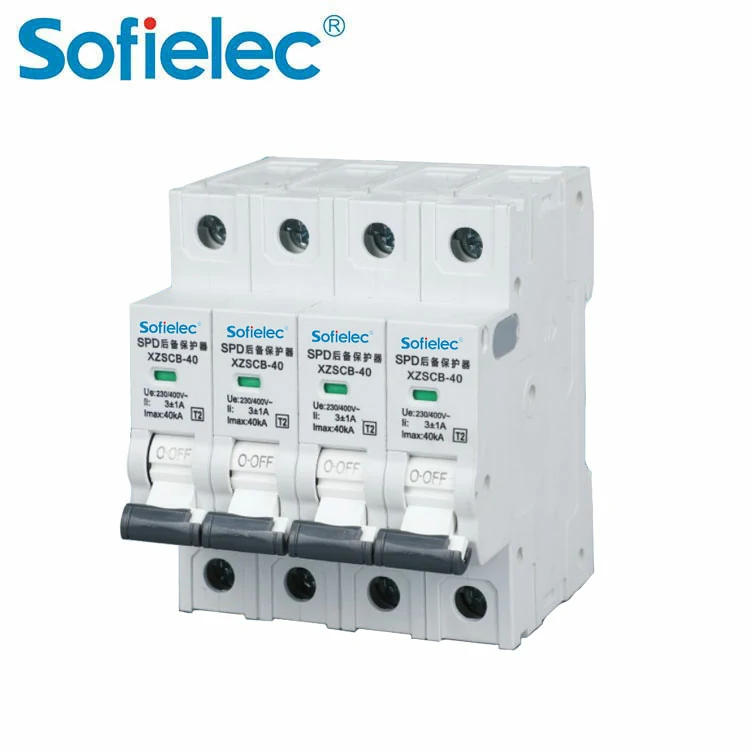
The standard solution is a fuse or circuit breaker upstream of the SPD. But a conventional fuse or breaker has a protection blind area—it may not clear the fault current quickly enough to prevent the SPD from overheating. The XZSCB SPD special backup protector is designed specifically to close that gap. It trips at a power frequency current of 3±1A, which is low enough to disconnect the SPD before the MOV generates enough heat to ignite the housing.
Short-Circuit Breaking and Selective Tripping
The backup protector carries a 100kA short-circuit breaking capacity, matching the SPD's own withstand rating. That coordination ensures that the backup device can clear the fault current without being destroyed by it.
The selective tripping mechanism is what separates a dedicated backup protector from a generic breaker. The protector distinguishes between a surge current, which it should pass, and a power-frequency fault current, which it should interrupt. That discrimination prevents nuisance tripping during normal surge events while still providing the fire-safety disconnection at end-of-life.
Where Does a 100kA SPD Fit in a 230V Panel?
A SPD Surge Protective Device in the 100kA class is specified for single-phase 230V panels in residential, commercial, and light industrial installations where the surge exposure is elevated. That covers buildings with rooftop solar, sites near a utility transformer, and facilities with outdoor equipment connected to the panel.
The XZSCB series is installed on a 35mm standard DIN rail in front of the SPD, with an induced power line cross-sectional area of 2.5–35mm² for multicore flexible cable. The IP20 protection grade suits installation inside an enclosure, and the -40°C to +80°C operating range covers the ambient conditions in most distribution rooms.
The remote indicating function can be added through an IOF accessory, which allows the SPD status to be monitored from a building management system. That remote signal is valuable in facilities where the panel is not checked daily.
What Should You Check Before Selecting an SPD?
How do I match the In and Imax ratings to my site?
Start with the exposure level. A residential panel with no outdoor cabling may be adequately protected by a 50kA In device. A building with a large rooftop PV array, a long outdoor feeder, or a location near a substation should specify a 100kA In device. If the site has a direct lightning protection system, the SPD should be coordinated with the lightning protection designer.
Does the SPD need a dedicated backup protector?
Yes, if the panel uses a conventional fuse or breaker as the only upstream protection. The XZSCB backup protector is designed to close the protection blind area that a generic breaker leaves. Confirm that the backup protector's trip current (3±1A) and breaking capacity (100kA) are coordinated with the SPD's ratings.
What is the difference between T1 and T2 test classes?
The T1 class is tested with a 10/350μs waveform, which simulates a direct lightning strike. The T2 class is tested with an 8/20μs waveform, which simulates an indirect strike or a switching transient. The XZSCB-100 is a T2 device with a 50kA In rating, while the XZSCB-120 and XZSCB-150 are T1 devices rated at 100kA In. Match the test class to the exposure: T1 for structures with external lightning protection, T2 for panels downstream of a T1 device.
Straight Answers on SPD Ratings
What does 100kA Imax mean in practice?
100kA Imax is the peak surge current the device can survive in a single event without failing. It is not the current it can handle repeatedly. The repeated-surge capability is defined by the In rating, which is 50kA for the XZSCB-100 and 100kA for the XZSCB-120/150.
[H3] xCan I use a 50kA SPD on a 100kA service panel?
The SPD rating is matched to the surge exposure, not the panel's ampacity. A 100A service panel in a low-exposure location may be adequately protected by a 50kA In device. A 200A panel in a high-exposure location may need a 100kA In device. The panel rating and the SPD rating are independent specifications.
[H3] What happens when the SPD reaches end-of-life?
The failure indicator shows red when the device is no longer effective. The backup protector disconnects the SPD from the circuit, preventing a short-circuit fire. The SPD cartridge is then replaced, and the backup protector is reset. The XZSCB series uses a pluggable cartridge design for straightforward replacement.
[H3] What does the 3±1A trip current protect against?
The 3±1A power frequency trip current is the threshold at which the backup protector disconnects the SPD. If the MOV fails and draws a fault current above that level, the protector opens the circuit. That threshold is low enough to protect the SPD from overheating, but high enough to avoid nuisance tripping during normal surge events.
[H2] Let's Match an SPD to Your 230V Panel
[H3] Share Your Exposure Level and Panel Configuration
An SPD Surge Protective Device for a single-phase 230V system should match your site's surge exposure and the panel's available DIN rail space—not the other way around. The Surge Protection Device For Single Phase 230V 50KA/100KA from Sofielec covers both the 50kA In and 100kA In classes on a 35mm DIN rail, with a 100kA short-circuit breaking capacity, a 3±1A trip current, and an optional IOF remote indication accessory. The matching XZSCB backup protector closes the protection blind area that a generic fuse or breaker leaves, and the pluggable cartridge simplifies replacement at end-of-life. If you're specifying surge protection for a residential or light commercial panel, send us your exposure level and panel configuration — we'll help you confirm the right In/Imax class and backup protector before you order.