English
 Español
How Does a Metal Distribution Box Protect UK Circuits?
You're wiring a garage or a small commercial unit in the UK, and the circuit breakers need a housing that protects them from impact and keeps fingers away from live terminals. A Metal Distribution Box provides that enclosure, mounting the breakers on a DIN rail inside a steel shell with the safety features required by UK wiring regulations. This article explains what these enclosures do, how the IP3X rating protects users, and what to verify when you're selecting one for a domestic or light commercial installation.
What Does a Consumer Unit Actually Do?
Housing, Mounting, and Protection
A consumer unit is the enclosure that houses the main switch, circuit breakers, and residual current devices for a domestic or light commercial installation. The box itself doesn't break the circuit — it provides the mechanical and environmental protection for the devices that do.
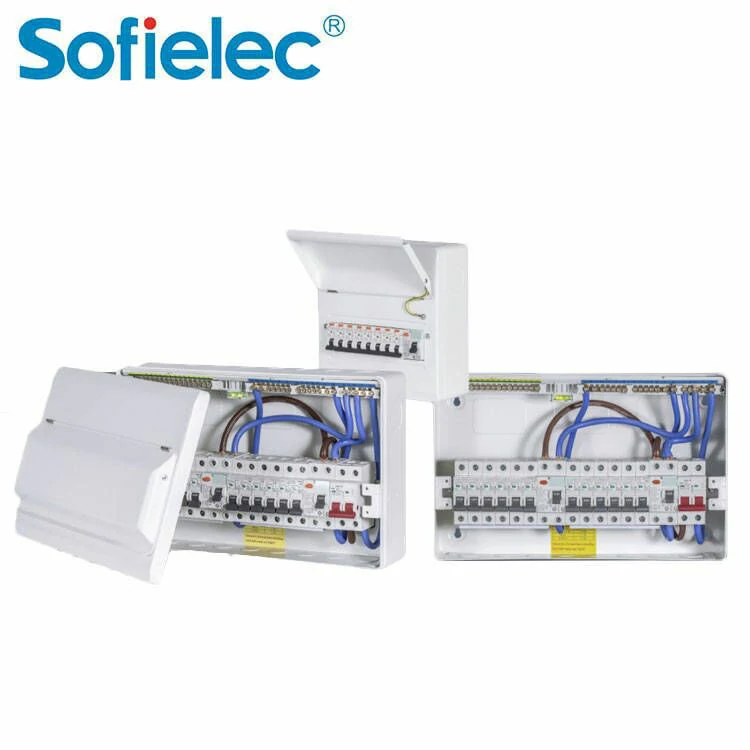
The CJDB series is a metallic compact consumer unit with a 100A current rating. It's designed for UK-style installations where the breakers need a metal enclosure rather than a plastic one. The metal housing provides impact resistance, fire containment, and a grounding path for the enclosure itself.
IP3X Safety and Finger Protection
The IP3X rating is the key safety specification. The "3" in the second digit means the enclosure protects against access to hazardous parts with a tool or wire thicker than 2.5mm. In practical terms, that means a finger can't reach the live terminals inside the box, and a typical screwdriver tip can't slip through the openings to touch a live conductor.
The IP3X rating also means the enclosure provides no protection against water — it's intended for indoor installation in dry locations. Garage units and consumer units inside a building fall into that category. If the enclosure is going outside or in a damp location, you'd need a higher IP rating or an additional weatherproof cabinet.
How Do the Earth and Neutral Blocks Work?
Fixed Blocks as Standard
The CJDB series includes earth and neutral blocks fixed as standard. Those blocks are the busbars where the circuit's earth conductors and neutral conductors terminate. In a UK consumer unit, the earth block connects to the main earthing terminal of the installation, and the neutral block connects to the supply neutral.
The blocks are fixed inside the enclosure, so the installer doesn't need to mount separate terminal bars. That simplifies installation and reduces the number of loose components that could come out of position. All metal parts of the enclosure are protected for grounding, which means the housing itself is bonded to the earth block so that a fault inside the box trips the protective device.
Insulated Comb Busbar and Neutral Cable
The CJDB series includes an insulated comb busbar and a neutral cable. The comb busbar is the component that distributes the live supply to the individual circuit breakers. An insulated busbar keeps the live conductors covered, which reduces the risk of accidental contact during installation and maintenance.
The neutral cable connects the neutral block to the supply neutral. Including these components means the installer has the internal wiring ready to go when the enclosure arrives, rather than sourcing separate busbars and cables.
| Parts No. | Description | Usable Ways |
|---|---|---|
| CJDB-4W | 4Way metal distribution box | 4 |
| CJDB-6W | 6Way metal distribution box | 6 |
| CJDB-8W | 8Way metal distribution box | 8 |
| CJDB-10W | 10Way metal distribution box | 10 |
| CJDB-12W | 12Way metal distribution box | 12 |
| CJDB-14W | 14Way metal distribution box | 14 |
| CJDB-16W | 16Way metal distribution box | 16 |
| CJDB-18W | 18Way metal distribution box | 18 |
| CJDB-20W | 20Way metal distribution box | 20 |
| CJDB-22W | 22Way metal distribution box | 22 |
Why Does the DIN Rail Design Matter?
Rigid, Raised, and Offset Rail
The DIN rail is the metal strip inside the enclosure where the circuit breakers clip on. The CJDB series uses a rigid, raised, and offset DIN rail design. The rail is rigid, so it doesn't flex when breakers are clipped on or removed. A flexing rail can cause breakers to sit at an angle, which affects the alignment of the busbar and the front cover.
The raised and offset design positions the breakers at a specific height and depth inside the enclosure. That positioning matters because the front cover has openings that line up with the breaker toggle switches. If the rail is at the wrong height, the toggles don't protrude correctly through the cover.
Multiple Cable Entry Knockouts
The enclosure has multiple cable entry knockouts, which are pre-scored openings in the metal that can be punched out for cable entry. Different installations require cables to enter from the top, bottom, or sides, and the knockouts give the installer options without drilling or cutting the enclosure.
Knockouts also preserve the IP3X rating better than field-drilled holes. A drilled hole has sharp edges and an irregular shape that may not seal properly. A knockout is formed with the enclosure and produces a clean, predictable opening.
Where Do Metal Consumer Units Get Used?
Domestic, Garage, and Light Commercial
The CJDB series is designed for domestic and light commercial installations. That covers the standard applications where a UK consumer unit or garage unit is required:
-
Garage units — a small consumer unit for a detached garage or outbuilding with a sub-main supply
-
Domestic consumer units — the main distribution board for a house or apartment
-
Light commercial boards — small shops, offices, and workshops that need a compact distribution enclosure
-
Extension boards — additional distribution points for extensions, conservatories, or garden rooms
-
Landlord supply units — separate consumer units for rented properties with individual metering
The 4-way to 22-way range covers the spread from a minimal garage unit with a main switch and a couple of circuits to a full domestic board with separate circuits for lighting, sockets, kitchen, and outbuildings. A Metal Distribution Box like the CJDB series from Sofielec is built for these installations, with compliance to BS/EN 61439-3 and a design that includes the earth and neutral blocks, comb busbar, and neutral cable as standard.
What Should You Check Before Selecting a Unit?
How do I choose the right number of ways?
Count the circuits you need and add spare ways for future expansion. A typical domestic installation uses separate circuits for upstairs lighting, downstairs lighting, upstairs sockets, downstairs sockets, kitchen sockets, immersion heater, and cooker. That's seven circuits, so a 10-way or 12-way board gives room for two or three spares. A garage unit with one lighting circuit and one socket circuit needs a 4-way or 6-way board.
What's the difference between usable ways and module ways?
The "ways" count in the CJDB series refers to usable ways — the number of circuit breakers the board can hold. Some manufacturers quote module ways, which is the total number of DIN rail modules, including the main switch. The CJDB series lists usable ways directly, so a CJDB-10W holds 10 circuit breakers.
What compliance standards apply?
The CJDB series complies with BS/EN 61439-3, which is the standard for distribution boards intended to be operated by ordinary persons. That's the relevant standard for domestic consumer units and similar installations. The compliance covers the enclosure's mechanical strength, thermal performance, and electrical safety.
What do I need to add to make a complete installation?
The CJDB series is the enclosure only. You'll need to add the main switch, circuit breakers, and residual current devices to complete the board. The enclosure includes the earth and neutral blocks, the insulated comb busbar, and the neutral cable, but the protective devices themselves are selected separately based on the circuit requirements.
What Do Installers Ask About Consumer Units?
Can I use this board for a three-phase installation?
No. The CJDB series is a single-phase consumer unit rated for 100A. It's designed for the single-phase 230V supply common in UK domestic and light commercial installations. For three-phase distribution, you'd need a different board with a three-phase busbar and a higher pole count.
What cable entry knockouts are provided?
The enclosure has multiple cable entry knockouts in different positions to accommodate top, bottom, and side cable entry. The exact knockout configuration varies by model size, but the design provides enough options to route cables without drilling the enclosure. Check the specific model's knockout layout against your cable routing plan.
How do I mount the enclosure?
The enclosure mounts on the wall using the installation holes in the back of the box. The install hole sizes vary by model — the CJDB-4W uses holes at 88mm and 174mm spacing, while the larger models use wider spacing. The mounting screws go through the back of the enclosure into the wall, and the enclosure sits flush against the surface.
What maintenance does the enclosure need?
The enclosure itself needs very little maintenance. Check the door hinge and latch for smooth operation. Inspect the earth and neutral block terminals for tightness during periodic inspections. Verify that the IP3X integrity is maintained — no missing knockouts, no damaged gaskets, and the cover fully closed. The internal components are the parts that need routine inspection, not the enclosure.
Let's Match a Distribution Board to Your Installation
Share Your Circuit Count and Application
A Metal Distribution Box should match your circuit count, installation location, and compliance requirements. The CJDB4W-22W series from Sofielec covers 4-way to 22-way configurations with a 100A current rating, IP3X safety, fixed earth and neutral blocks, an insulated comb busbar, and compliance to BS/EN 61439-3. The metal enclosure is designed for domestic, garage, and light commercial installations where a UK-style consumer unit or garage unit is required. If you're specifying a distribution board for a residential or light commercial project, send us your circuit count and application details — we'll help you confirm the right model before you order.