English
 Español

How Does a Circuit Breaker Fit an 18mm Module?
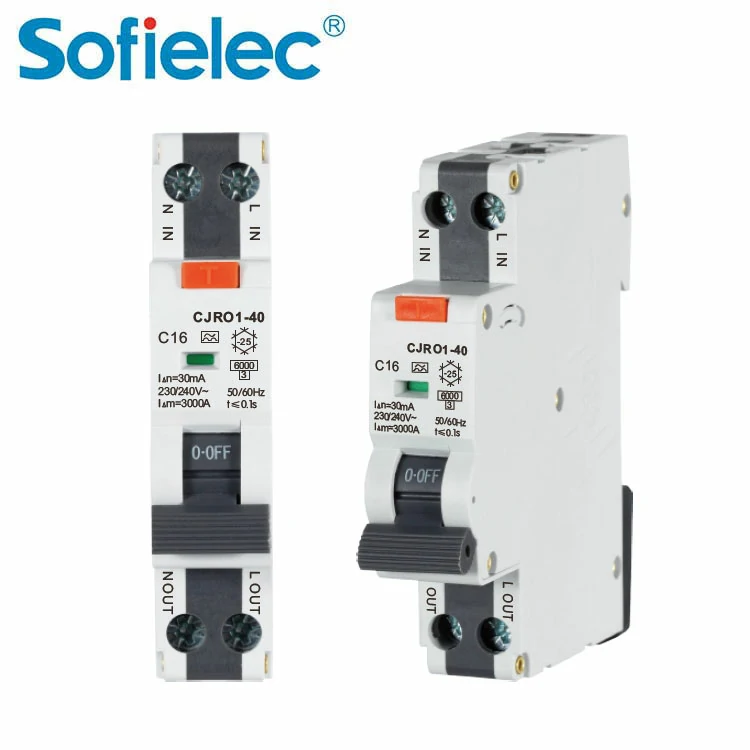
You open a final distribution board and see a row of breakers packed tightly together. Each one has to protect a circuit against overload, short circuit, and earth leakage, but the available DIN rail space is finite. A Circuit Breaker built as an 18mm single-module RCBO solves that space problem by combining overcurrent and residual current protection in the width of a single standard module. The CJR01-40(NEW) from Sofielec is one such device, rated 6kA with 1P+N switching and B or C curve tripping. This article explains how the compact housing fits an RCBO into 18mm, what the 1P+N configuration means for the neutral, and what to verify when you're specifying one for a compact panel.
What Fits Inside an 18mm Housing?
Overcurrent and Residual Current in One Body
A standard MCB occupies one 18mm module. A standard RCBO—combining overcurrent and residual current protection—often occupies two modules, because the residual current sensing coil and the trip mechanism need additional space. The CJR01-40(NEW) compresses that assembly into a single 18mm module by integrating the toroidal current transformer, the residual current trip circuit, and the overcurrent protection into a shared housing.
The result is a device that provides both functions in the same rail width as a simple MCB. For a panel builder working with a fixed enclosure size, that space saving can mean the difference between fitting all the outgoing ways and requiring a larger board.
6kA Breaking Capacity
The rated breaking capacity is 6kA. That figure defines the maximum prospective short-circuit current the device can interrupt safely. In a typical residential or light commercial final circuit, the prospective fault current at the outlet is often well below 6kA, so the 6kA rating provides adequate margin. For installations closer to the transformer, the prospective current may be higher, and the upstream protection must be coordinated with the device's rating.
| Parameter | CJR01-40(NEW) 18mm RCBO |
|---|---|
| Poles | 1P+N |
| Rated current | 6A–40A (model-dependent) |
| Breaking capacity | 6kA |
| Tripping curve | B or C |
| Residual current | 30mA, 100mA, 300mA (model-dependent) |
| Width | 18mm (single module) |
| Standard | IEC 61009-1 |
| Mounting | 35mm DIN rail |
| Terminal capacity | Up to 25mm² |
Why Does 1P+N Switching Matter?
A 1P+N device switches both the phase and the neutral. When the breaker is opened, the neutral is disconnected along with the live conductor. That switching action matters in installations where the neutral is not reliably at earth potential—for example, in TT systems or where the neutral is shared across circuits.
The neutral switching also simplifies maintenance. A technician working on a circuit can open the device and know that both conductors are isolated, rather than relying on a separate neutral disconnect. The CJR01-40(NEW) provides that dual switching in the same 18mm width, without requiring a separate neutral pole.
How Do B and C Curves Differ?
A B-curve device trips between 3 and 5 times its rated current. It is suited to resistive loads—lighting, heaters, socket outlets with predominantly resistive appliances—where the inrush current is low.
A C-curve device trips between 5 and 10 times its rated current. It tolerates higher inrush, which makes it suitable for inductive loads such as small motors, transformers, and fluorescent lighting banks. The CJR01-40(NEW) is available in both curves, so the same 18mm platform can cover the mixed load types in a typical distribution board.
Where Does an 18mm Device Fit in a Distribution Board?
A compact 18mm RCBO is used in final distribution boards where space is tight and the outgoing ways are numerous. That includes residential consumer units, small retail panels, workshop boards, and light commercial distribution boards.
The single-module width allows a panel builder to fit more outgoing circuits into a standard enclosure. Instead of dedicating two modules per RCBO-protected circuit, the builder can use one module and free the adjacent space for another circuit or for a surge protection device. The CJR01-40(NEW) from Sofielec is designed for that application, with a 35mm DIN rail mount and a terminal capacity up to 25mm².
What Should You Check Before Installing a Single-Module RCBO?
Does the device match the circuit's trip curve?
Check the load type before selecting the curve. Resistive loads and general socket outlets are usually served by a B curve. Motors, transformers, and lighting with high inrush need a C curve. Using a B curve on a motor circuit can cause nuisance tripping at startup; using a C curve on a resistive circuit may delay the trip on a genuine overload.
What residual current sensitivity do I need?
The CJR01-40(NEW) is available with 30mA, 100mA, or 300mA residual current sensitivity. For final circuits protecting people, 30mA is the standard. Higher sensitivities are used for selective coordination with upstream devices or for fire protection, but they reduce the level of direct personnel protection.
What is the terminal capacity?
The terminals accept up to 25mm² conductors. Confirm the cable size against the terminal range before installation. A cable that's too large won't fit; one that's too small may not be gripped securely, which raises resistance and creates a hot spot.
What maintenance does the device need?
The RCBO includes a test button to verify the residual current function. Press it periodically according to the manufacturer's schedule or the site maintenance procedure. Check the terminals for tightness during periodic inspections. The device has no user-serviceable internal parts; if it fails the test or trips repeatedly without a fault, replace it.
What Do Installers Ask About Compact Protection?
Can an 18mm RCBO replace a standard two-module device?
Yes, in panels where the outgoing circuit needs both overcurrent and residual current protection and the rail space is limited. The 18mm device provides the same functions as a two-module RCBO, but in half the width. Confirm that the terminal capacity and the breaking capacity match the circuit requirements.
Is the 6kA rating enough for residential panels?
For most residential final circuits, yes. The prospective fault current at a socket outlet in a typical domestic installation is often below 6kA. For installations close to the distribution transformer, or for commercial panels with larger supplies, check the prospective fault current and coordinate the upstream protection.
Why does the device have a test button?
The test button simulates a residual current fault and verifies that the trip mechanism operates. It's a functional check, not a calibration. Pressing the button periodically confirms that the residual current sensing circuit is alive, but it doesn't measure the actual trip threshold.
Does the 1P+N configuration require a separate neutral bar?
No. The device switches the neutral internally, so the neutral conductor connects to the device's neutral terminal and is switched along with the phase. That eliminates the need for a separate neutral disconnect for the protected circuit.
Let's Specify Compact Protection for Your Panel
Share Your Circuit Current and Load Type
A Circuit Breaker in the 18mm single-module format should match your circuit current, load type, and residual current sensitivity—not the other way around. The CJR01-40(NEW) 18mm Single Module RCBO from Sofielec delivers 6kA breaking capacity, 1P+N switching, B or C curve tripping, and 30mA/100mA/300mA residual current options in a single 18mm module. The 35mm DIN rail mount and 25mm² terminal capacity suit compact final distribution boards in residential and light commercial installations. If you're laying out a panel with limited rail space, send us your circuit current and load type — we'll help you confirm the right curve and sensitivity before you order.