English
 Español

How Does an SPD Surge Protective Device Clamp Transients?
You're specifying surge protection for a distribution board, and you've already selected the L-N and L-PE devices. The neutral-to-earth path is the last piece—the one that catches common-mode surges and completes the protection scheme in TT and TN-S systems. An SPD Surge Protective Device in the N-PE position doesn't use the same metal-oxide varistor technology as the phase-side units. It relies on a spark gap or gas discharge tube that sits as a true open circuit until a transient forces it to conduct. This article explains why the N-PE position needs a different technology, how the XZ-NPE 275V device responds to a surge in nanoseconds, and what to verify when you're completing a distribution board's protection scheme.
Why Does the N-PE Position Need Different Technology?
The Varistor Limitation Between Neutral and Earth
A metal-oxide varistor (MOV) is the standard protective element for L-N and L-PE positions. It has a defined clamping voltage and a gradual conduction curve: as the voltage rises, the MOV's resistance drops and it shunts current to ground. That gradual response is acceptable when the device sits between a phase and neutral, where the normal operating voltage is stable.
The N-PE position is different. In a TT or TN-S system, the neutral is bonded to earth at the transformer or at the service entrance, so the normal voltage between N and PE is close to zero. A varistor in that position would see almost no voltage during normal operation—but it would also have a finite leakage current and a limited ability to handle the high common-mode surge currents that arrive on the neutral.
The Spark Gap as a True Open Circuit
A spark gap—or a gas discharge tube, which is a sealed spark gap—behaves differently. At normal operating voltage, the gap is a genuine open circuit. There's no leakage current, no gradual conduction, and no degradation from continuous exposure to the line voltage. When a transient arrives and the voltage across the gap exceeds its spark-over threshold, the gas ionizes and the gap becomes a low-resistance path in nanoseconds.
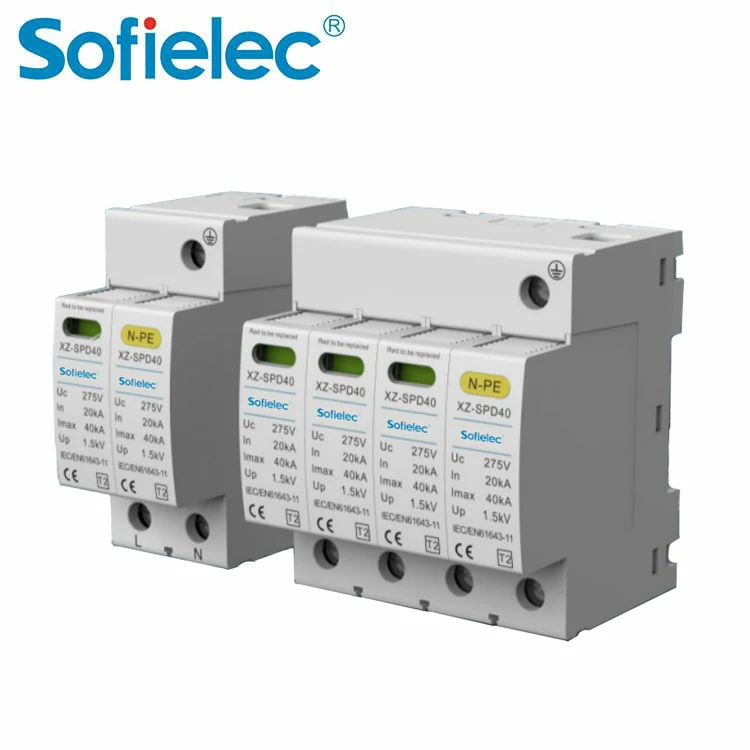
The XZ-NPE 275V uses a gas discharge tube or air discharge gap as the main component. The electrodes sit in a high-resistance state between the neutral and earth terminals. When a lightning surge or other transient overvoltage arrives, the electrodes conduct within nanoseconds and divert the surge to earth. When the surge passes, the gap returns to its high-resistance state and normal operation resumes without affecting the grid.
| Parameter | XZ-NPE 275V Specification |
|---|---|
| Number of poles | 1P+N, 3P+N |
| Nominal discharge current In (8/20μs) | 5, 10, 20, 30, 40 kA (model-dependent) |
| Maximum discharge current Imax (8/20μs) | 10, 20, 40, 60, 80 kA (model-dependent) |
| Max. continuous operating voltage Uc | 275V AC |
| Response time | <25ns |
| Protection grade | IP20 |
| Failure indicator | Green normal, red ineffective |
| Test classification | Class II |
| Ambient temperature | -40°C to +80°C |
| Installation | 35mm standard DIN rail |
| Connection capacity | 2.5–35mm² |
| Standards | GB18802.1, GB50057, IEC61643-1 |
How Does the Spark Gap Respond in Nanoseconds?
Ionization and Arc Formation
When a transient overvoltage reaches the gap, the electric field between the electrodes exceeds the dielectric strength of the gas or air. The gas molecules ionize, creating a conductive plasma channel between the electrodes. That channel collapses the resistance from near-infinite to a few ohms or less, and the surge current flows through the gap to the PE conductor.
The response time is <25ns. That speed matters because a lightning-induced transient rises to its peak in microseconds. If the protective device takes longer than the surge's rise time to react, the peak voltage reaches the downstream equipment before the clamp engages. A 25ns response means the gap is already conducting while the surge is still rising.
Arc Extinguishing and Reset
After the surge passes, the arc inside the gap has to extinguish so the device can return to its open-circuit state. The gap geometry and the gas composition are designed to quench the arc at the first current zero crossing. Once the arc extinguishes, the electrodes cool and the gap returns to its high-resistance state.
That self-resetting behavior is what allows the device to protect against multiple surges over its service life. Unlike a fuse or a one-shot device, the spark gap doesn't need replacement after every transient—it resets and waits for the next event.
What Do the Discharge Ratings Mean for System Protection?
Nominal vs. Maximum Discharge Current
The nominal discharge current (In) is the 8/20μs current the device can handle repeatedly without degradation. The XZ-NPE series offers In values of 5kA, 10kA, 20kA, 30kA, and 40kA depending on the model. The maximum discharge current (Imax) is the peak current the device can survive in a single event—10kA to 80kA across the range.
For a residential distribution box or a small commercial panel, the lower end of the range (In 5–10kA, Imax 10–20kA) covers the typical surge exposure. For a computer center or an industrial control panel with sensitive equipment and a higher likelihood of severe transients, the higher end (In 20–40kA, Imax 40–80kA) provides more margin.
Common-Mode and Differential-Mode Protection
The XZ-NPE device works in combination with phase-side SPDs to provide both common-mode (MC) and differential-mode (MD) protection. The N-PE device handles the common-mode path—the surge that appears on both the phase and neutral conductors relative to earth. The phase-side devices handle the differential-mode path between the live conductors.
The combination solutions include 1P+NPE and 3P+NPE arrangements. In a 1P+NPE configuration, the phase-side SPD protects L-N and L-PE, while the N-PE device completes the protection for the neutral-to-earth path. In a 3P+NPE configuration, three phase-side devices cover the three phases, and the N-PE device covers the neutral.
Where Does an N-PE Device Fit in a Distribution Board?
TT and TN-S Systems
The XZ-NPE series is designed for TT, TN-S, and other power supply systems operating at 50/60Hz and 230/400V and below. In a TT system, the neutral is grounded at the source and the installation has its own local earth electrode. In a TN-S system, the neutral and protective earth are separate conductors throughout the installation.
In both systems, the N-PE SPD sits between the neutral busbar and the earth bar. It's typically installed alongside the phase-side SPDs in the same distribution board, sharing the 35mm DIN rail and the same earthing conductor.
Residential, Commercial, and IT Applications
The device is installed in residential distribution boxes, computer centers, information equipment, electronic equipment, and control equipment near the socket box. In a residential board, the N-PE SPD completes the protection for the whole house. In a computer center or a control room, it protects the sensitive electronics that are most vulnerable to common-mode transients.
A SPD Surge Protective Device in the XZ-NPE series from Sofielec covers the N-PE path with a 275V maximum continuous operating voltage, <25ns response time, and discharge ratings from 5kA to 40kA nominal. The device complies with GB18802.1, GB50057, and IEC61643-1, and the green/red status window gives a visual indication of the protective element's condition.
What Should You Verify Before Installing an N-PE Device?
How do I match the discharge rating to my system?
Check the exposure level of the installation. A residential board in a suburban area sees lower surge energy than a computer center in an industrial zone. Match the In and Imax ratings to the expected surge environment, and verify that the N-PE device's rating is coordinated with the phase-side SPDs so that the entire protection scheme has a consistent capacity.
What wire size and length should I use?
The neutral connection uses 2.5–35mm² wire, and the earth connection uses a double-color multi-strand copper conductor of at least 6mm². The earth lead length should not exceed 500mm. That length limit is critical: a long earth lead adds inductance, which slows the device's response and raises the residual voltage at the equipment terminals.
What does the status indicator tell me?
The window shows green for normal operation and red when the device has reached end-of-life. The red indication means the discharge gap is no longer capable of protecting the circuit and the device should be replaced. Check the window during periodic maintenance and after any known surge event.
Can the device be customized for a different voltage?
Yes. The standard Uc is 275V AC, but other maximum continuous operating voltages can be customized. If the system voltage or the earthing arrangement requires a different Uc, confirm the customization with the supplier at the ordering stage. A remote signal function can also be added for monitoring from a central system.
Straight Answers on N-PE Surge Protection
Why can't I use a varistor-based SPD in the N-PE position?
A varistor has a finite leakage current and a gradual conduction curve. In the N-PE position, where the normal voltage is close to zero, a varistor may not provide the clean open-circuit isolation that the position requires. A spark gap or gas discharge tube is a true open circuit at rest, which is why it's the preferred technology for the N-PE path in TT and TN-S systems.
What's the difference between a spark gap and a gas discharge tube?
Both are voltage-switching devices that change from high impedance to low impedance when the voltage across them exceeds a threshold. A gas discharge tube is a sealed envelope containing a noble gas, which gives it a more defined spark-over voltage and a longer service life. An air spark gap uses the ambient air as the dielectric, which is simpler but more sensitive to humidity and contamination. The XZ-NPE series can use either technology.
Does the N-PE device need a backup fuse?
The N-PE device is a spark-gap type, which is a true open circuit at rest. It doesn't have the same failure mode as a varistor, which can short-circuit at end-of-life. However, the device should still be installed according to the manufacturer's recommendations and the local wiring regulations, which may require a backup fuse or a coordinated breaker for the phase-side SPDs. Check the installation instructions for the specific configuration.
How do I test the device after installation?
The status window is the primary field indicator. For a more thorough check, a surge protection tester can measure the spark-over voltage and verify that the gap still operates within specification. Routine visual inspection of the window, combined with periodic testing according to the site's maintenance schedule, is the standard practice.
Let's Complete Your Distribution Board Protection
Share Your System Earthing and Surge Exposure
An SPD Surge Protective Device in the N-PE position is the final piece of a coordinated protection scheme. The XZ-NPE 275V Surge Protector 20KA/40KA from Sofielec uses spark-gap technology to clamp neutral-to-earth transients at 275V Uc with a <25ns response time, available in 5kA to 40kA nominal and 10kA to 80kA maximum discharge ratings. The device mounts on a 35mm DIN rail, accepts 2.5–35mm² conductors, and complies with IEC61643-1. If you're completing a TT or TN-S distribution board for a residential, commercial, or IT installation, send us your system earthing and surge exposure — we'll help you confirm the right discharge rating before you order.