English
 Español
How Does a DC Series Circuit Breaker Speed Up Fault Finding?
You're troubleshooting a tripped circuit in a DC power system, and the first question is always the same: did it trip because of a fault, or did someone switch it off? A DC series circuit breaker that can't tell you the difference forces you to waste time chasing the wrong problem. The JVM16-63 DC series low-voltage circuit breaker was engineered with fault finding as a priority: a handle that stays at the central position when tripped by overload or short circuit, making fault identification immediate. This article walks through what makes this breaker a practical choice for reducing downtime—from the central-staying trip indication that eliminates guesswork to the lockout features that prevent unauthorized operation.
What Electrical Maintenance Teams Notice First on the Job
Two Practical Questions—Answered Up Front
Q: How does the breaker indicate a fault trip versus a manual switch-off?
A: The JVM16-63 features a handle central-staying function for circuit fault indication. In case of overload or short circuit, the MCB handle trips and stays at the central position, which enables a quick solution to the faulty line. The handle cannot stay in such position when operated manually, so if you see the handle in the central position, you know the breaker tripped due to a circuit fault—not because someone switched it off.
Q: What current ratings and trip curves are available?
A: The JVM16-63 is available in current ratings from 1A to 63A with B and C trip curves. B curve is typically used for resistive loads, while C curve is suited for inductive loads with higher inrush currents.
Central-Staying Trip Indication — The Feature That Eliminates Guesswork
The JVM16-63's most distinctive feature is its handle central-staying function. This isn't a minor detail—it's a feature that directly impacts how quickly you can restore service after a trip.
How the Central Position Tells You What Happened
When the breaker trips due to overload or short circuit, the handle stays at the central position, which enables a quick solution to the faulty line. The handle cannot stay in such position when operated manually. So if you see the handle in the central position, you know the breaker tripped due to a circuit fault—not because someone switched it off.
Faster Troubleshooting, Less Downtime
Knowing immediately that it was an automatic trip (not a manual switch-off) directs your troubleshooting to the circuit itself rather than questioning operator actions. This speeds up fault finding and reduces system downtime.
Lockout and Terminal Security — Protecting Against Unauthorized Access
The JVM16-63 includes two security features that protect against accidental or unauthorized operation.
Handle Padlock Device for LOTO Compliance
The MCB handle can be locked either at the ON position or at the OFF position to prevent unwanted operation of the product. This is essential for lockout/tagout (LOTO) procedures where equipment must remain de-energized during maintenance.
Screw Terminal Lock Device for Secure Connections
The lock device prevents unwanted or casual dismounting of connected terminals. Loose connections are a common source of overheating and failure; this feature ensures that terminals stay secure once torqued to specification.
Breaking Capacity and Arc Extinguishing — Clearing Faults Safely
The JVM16-63 is rated for 10kA short-circuit breaking capacity across the full range, with 15kA capacity for current ratings up to 40A.
What 10kA Means for Your System
A 10kA interrupting rating means the breaker can safely clear a fault current of 10,000 amps without welding contacts or catastrophic failure. For DC circuits where arcing is more difficult to extinguish than in AC circuits, this rating provides the margin needed for reliable protection.
The Arc Extinguishing System That Makes It Possible
The high short-circuit capacity is achieved through a powerful electric arc extinguishing system. This system rapidly quenches the arc that forms when contacts open under fault conditions, ensuring the breaker clears the fault safely and without damage.
Electrical Endurance and Quick Making — Built for Long Service Life
The JVM16-63 is rated for 10,000 electro-mechanical cycles, providing long-term reliability in applications where the breaker operates frequently.
What 10,000 Cycles Means in Practice
In a typical application, 10,000 operations represents years of service life. The long electrical endurance up to 6,000 cycles is achieved through the quick making mechanism, which reduces contact wear during switching.
Quick Making Mechanism for Reduced Wear
The quick making mechanism ensures rapid contact closure during switching, minimizing arcing and contact wear. This extends the service life of the breaker and maintains its performance over thousands of operations.
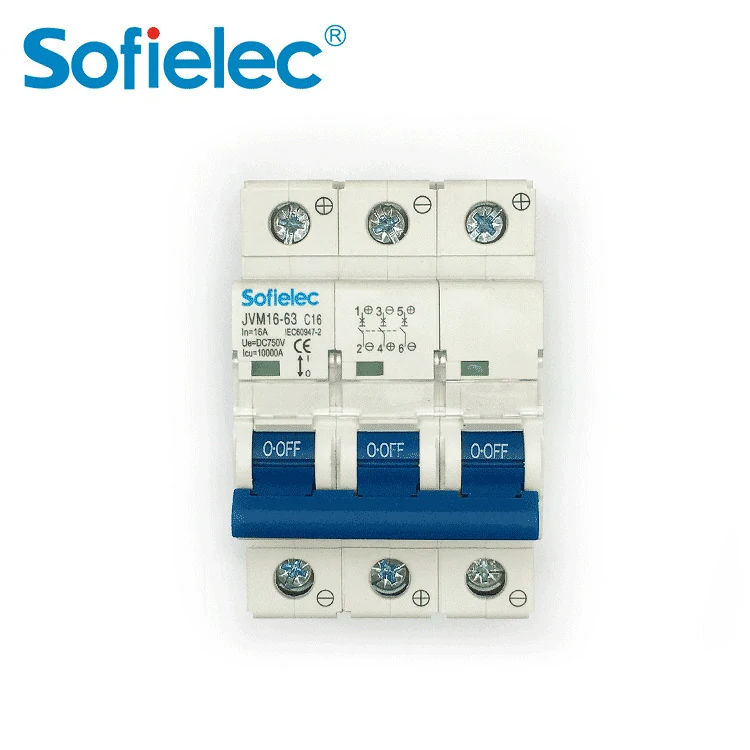
Specifications at a Glance — JVM16-63 DC Series
| Parameter | Specification |
|---|---|
| Model | DC JVM16-63 |
| Pole No. | 1, 2 |
| Rated Voltage | 1P: 250V / 2P: 500V |
| Rated Current | 1, 2, 3, 4, 6, 10, 13, 16, 20, 25, 32, 40, 50, 63A |
| Tripping Curve | B, C |
| Rated Short-Circuit Breaking Capacity | 10kA (15kA up to 40A) |
| Rated Impulse Withstand Voltage | 6.2kV |
| Electro-Mechanical Endurance | 10,000 cycles |
| Screw Terminal | M5 |
| Rated Torque | 2.0 N·m |
| Handle Feature | Central-staying trip indication, padlockable |
| Terminal Feature | Lock device prevents casual dismounting |
Applications Where Fault Finding Speed Matters Most
The JVM16-63 serves multiple applications where minimizing downtime is critical:
Battery and Energy Storage Systems
DC breakers are the primary protection for battery banks and energy storage systems. When a breaker trips in a critical battery system, every minute of downtime costs money. The central-staying trip indication tells you immediately whether it was a fault or a manual operation, directing your response accordingly.
Solar PV Systems
Solar arrays produce DC power that requires dedicated overcurrent protection. In large PV installations, troubleshooting a tripped string can be time-consuming. The JVM16-63's central-staying indication speeds up the process by confirming a fault condition before you start testing.
Industrial Control Circuits
Many industrial control systems use DC power supplies. When a control circuit trips, production stops. The breaker's fault indication helps maintenance teams get production back online faster.
Telecommunications Equipment
Telecom power systems operate on DC voltage. In telecom applications, uptime is measured in "five nines." The JVM16-63's quick fault identification supports the high availability requirements of telecom infrastructure.
Straight Answers on DC Circuit Breakers
Q: What current ratings are available for the JVM16-63?
A: The breaker is available in 1A, 2A, 3A, 4A, 6A, 10A, 13A, 16A, 20A, 25A, 32A, 40A, 50A, and 63A ratings.
Q: What is the short-circuit breaking capacity?
A: The breaker provides 10kA breaking capacity for the full range, with 15kA for ratings up to 40A.
Q: What is the rated impulse withstand voltage?
A: The rated impulse withstand voltage is 6.2kV.
Q: How does the central-staying trip indication work?
A: When the breaker trips due to overload or short circuit, the handle stays at the central position, indicating a fault trip rather than a manual switch-off.
Q: Can the breaker be locked out?
A: Yes. The handle can be locked at either the ON or OFF position to prevent unauthorized operation.
Q: What is the electro-mechanical endurance?
A: The breaker is rated for 10,000 electro-mechanical cycles.
Q: What is the rated torque for terminal connections?
A: The rated torque is 2.0 N·m.
Request a Quote for Your DC Protection Needs
A DC series circuit breaker that combines central-staying trip indication for faster fault finding, 10kA breaking capacity (15kA up to 40A), handle padlock and terminal lock devices for security, and 10,000-cycle electrical endurance is the foundation of any reliable DC protection system. The JVM16-63 from SofiElEC delivers all of these features in a compact design available in 1A to 63A ratings with B and C trip curves.
Whether you're protecting battery banks, solar PV systems, industrial DC controls, or telecom equipment, the JVM16-63 offers the performance and reliability that electrical engineers require. With 1P and 2P configurations available, it covers a wide range of DC voltage applications.
Contact SofiElEC for a quote or technical consultation → their team can help you select the right pole configuration, current rating, and trip curve for your specific DC protection requirements. Get a DC circuit breaker that tells you what happened—so you can fix it faster.