English
 Español
Application Guide for Hydraulic Magnetic Circuit Breakers in Sensitive Electronic Equipment
You‘ve designed a power supply for a medical diagnostic system. The circuit breaker you selected works perfectly in the lab. But in the field—where the equipment room runs warmer than the test bench—the breaker trips prematurely. Or worse, it doesn’t trip when it should. The problem isn‘t the design. It’s the breaker.
Standard thermal magnetic circuit breakers rely on a bimetallic strip that bends with heat. When the ambient temperature changes, the trip threshold changes with it. In sensitive electronic equipment—UPS systems, medical devices, telecom base stations—that temperature drift can mean nuisance trips or failed protection. A hydraulic electromagnetic circuit breaker solves this problem. Instead of a bimetallic strip, it uses a coil, iron core, and silicone oil damping to provide a trip curve that remains stable across temperature extremes. The Sofielec B3, B2, and B1 series are engineered for applications where protection precision matters. This guide covers what makes hydraulic magnetic breakers different, where they excel, and how to select the right delay curve for your equipment.
What makes hydraulic magnetic breakers different — no temperature drift
The core difference between thermal magnetic and hydraulic magnetic breakers is how they sense overcurrent.
The thermal magnetic problem: temperature drift
Thermal magnetic breakers use a bimetallic strip. When current flows, the strip heats up and bends. At the trip threshold, it releases the mechanism. The problem: the strip‘s temperature depends on both the current and the ambient temperature. In a 60°C equipment cabinet, the strip is already warm—so it trips at a lower current than its rated value. In a cold environment, it may not trip at all. For sensitive electronics, this inconsistency is unacceptable.
The hydraulic magnetic solution: stable protection
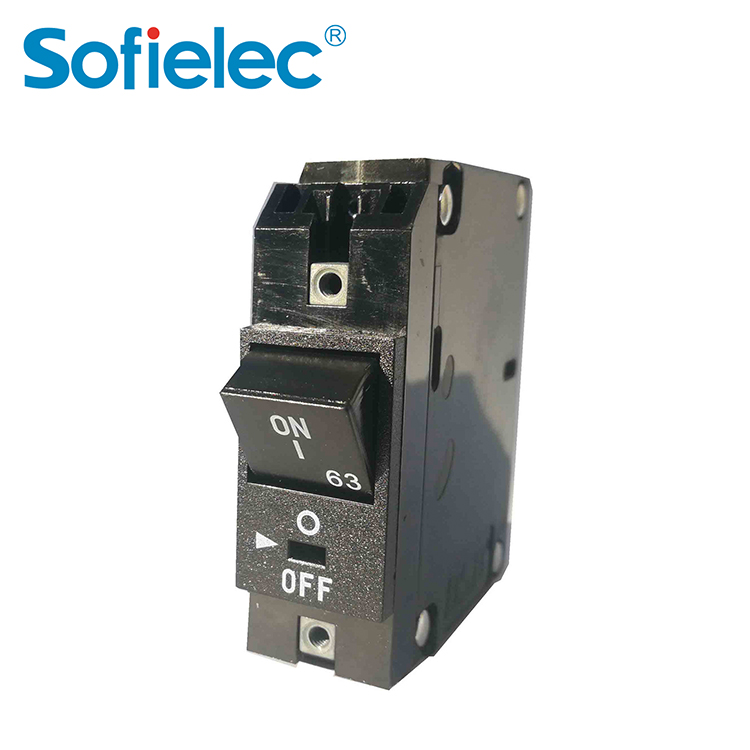
Hydraulic magnetic breakers replace the bimetallic strip with a solenoid coil, an iron core, and a silicone oil-filled timing tube. When current flows through the coil, it generates a magnetic field that pulls the iron core through the oil. The oil creates a damping effect that determines the delay time. The key advantage: the oil‘s viscosity changes very little with temperature. The trip curve remains stable across the entire operating range.
The Sofielec B3, B2, and B1 series operate from –40°C to +85°C. That’s a 125°C span with minimal drift—far wider than most thermal magnetic breakers can handle.
Side‑by‑side comparison
| Feature | Thermal Magnetic | Hydraulic Magnetic (Sofielec B Series) |
|---|---|---|
| Temperature influence | Significant (±20% drift) | Negligible (±5% or less) |
| Operating temperature range | Limited (0°C to 50°C typical) | –40°C to +85°C |
| Trip mechanism | Bimetallic strip (heat‑sensitive) | Solenoid + oil damping (current‑sensitive) |
| Typical applications | Lighting, motors, general purpose | UPS, medical, telecom, test instruments |
| Agency certifications | Varies | EN60934, UL1077, GB17701, UL489A |
Key applications where hydraulic magnetic breakers excel
The temperature stability and precise trip curves of hydraulic magnetic breakers make them the right choice for several critical equipment categories.
UPS systems and inverters
UPS systems run warm—often significantly above room temperature. Thermal magnetic breakers inside a UPS can nuisance-trip simply because the ambient heat pushes them over the threshold. A hydraulic magnetic breaker maintains its trip point regardless of internal cabinet temperature. For UPS and inverter manufacturers, this means fewer false trips and more reliable power protection.
Medical diagnostic equipment
MRI, CT, and X‑ray systems require uninterrupted power for patient safety and image quality. A nuisance trip during a scan is not just an inconvenience—it‘s a patient safety issue and a costly rescan. Hydraulic magnetic breakers provide the stable protection that medical equipment demands.
Telecom base stations and data center PDUs
High‑density equipment racks create uneven temperature zones. A breaker at the top of a rack may see 10°C higher ambient than one at the bottom. With thermal magnetic breakers, the same current could trip one but not the other. Hydraulic magnetic breakers eliminate this variability.
Test and measurement instruments
Laboratory instruments often operate in temperature‑controlled environments—but not always. Field instruments may see temperature swings that would confuse a thermal magnetic breaker. Hydraulic magnetic breakers keep test runs from being interrupted by temperature‑related nuisance trips.
Choosing the right delay curve
The Sofielec B3, B2, and B1 series offer multiple delay curves—D, A, H, and G—each designed for different load types. Selecting the right curve is as important as selecting the right current rating.
Understanding the delay curve types
| Delay Type | Typical Use | Trip Behavior |
|---|---|---|
| D series | General purpose | Moderate delay; standard protection |
| A series | Sensitive electronics | Faster trip; tighter protection |
| H series | High inrush loads | Longer delay; tolerates startup surges |
| G series | Motor and inductive loads | Extended delay; handles repetitive surges |
Sizing for switch‑mode power supplies
Switch‑mode power supplies draw high inrush current at startup—often 5‑10 times the steady‑state current for a few milliseconds. A breaker with a D or H curve will tolerate this surge without tripping, while an A curve might nuisance‑trip. For a PLC rack with a 3.2A steady‑state load and a 22A inrush surge, a 5A breaker with a short‑delay curve would be the appropriate selection.
Sizing for motor loads
Motors draw inrush current that can last 100‑500 milliseconds. For motor loads in HVAC or pump applications, a G curve provides the extended delay needed to start the motor without tripping.
Below is a reference for Sofielec B series specifications:
| Series | Max Voltage | Current Range | Poles | Weight | Typical Use |
|---|---|---|---|---|---|
| B1 | 250V AC / 80V DC | 1A – 30A | 1, 2 | ~30g/pole | Compact equipment, low‑current applications |
| B2 | 277V AC / 80V DC | 1A – 50A | 1, 2, 3 | ~65g/pole | Medium‑current industrial and IT equipment |
| B3 | 480/277V AC / 80V DC | 1A – 100A | 1, 2, 3 | ~110g/pole | High‑current UPS, medical, and telecom |
Frequently asked questions from equipment manufacturers
Q: Can hydraulic magnetic breakers be used in DC circuits?
A: Yes. The Sofielec B3, B2, and B1 series are rated for DC operation up to 80V DC. The B3 series also offers DC short‑circuit capacity up to 7,500A without backup fuse. Note that DC circuits require proper polarity—the B1 series is polarity‑sensitive for DC applications.
Q: Are hydraulic magnetic breakers more expensive than thermal magnetic?
A: Hydraulic magnetic breakers typically cost 15‑25% more than thermal magnetic equivalents. However, in sensitive electronic applications—UPS systems, medical devices, telecom infrastructure—the cost of a nuisance trip or a missed protection event far exceeds the breaker price difference. The total cost of ownership favors hydraulic magnetic breakers where protection reliability matters.
Q: Do hydraulic magnetic breakers require derating at high altitude?
A: Hydraulic magnetic breakers are less affected by altitude than thermal magnetic breakers because they don‘t rely on convective heat transfer. However, for installations above 2,000 meters, consult the manufacturer for specific derating guidance. The operating temperature range of –40°C to +85°C covers most environmental conditions without derating.
Q: Can I get a 1‑pole hydraulic magnetic breaker for both AC and DC?
A: Yes. Sofielec B series breakers are available in 1‑pole configurations rated for both AC and DC operation. Check the voltage rating: for the B1 series, 250V AC and 80V DC; for the B2 series, 277V AC and 80V DC; for the B3 series, 480/277V AC and 80V DC. Always verify that the voltage and current ratings match your application.
Q: What certifications do Sofielec B series breakers hold?
A: The B3, B2, and B1 series are certified to EN60934, UL1077, GB17701, and UL489A. These certifications cover both North American and international standards, making the breakers suitable for equipment sold in multiple regions.
How Sofielec B series breakers support sensitive equipment design
Sofielec’s B3, B2, and B1 series hydraulic electromagnetic circuit breakers are built for the specific demands of sensitive electronic equipment. The operating temperature range of –40°C to +85°C covers everything from outdoor telecom cabinets to climate‑controlled data centers. The insulation resistance of minimum 100 Megohms at 50V DC ensures reliable isolation in high‑impedance circuits.
The B3 series offers the widest range—up to 480/277V AC and 100A—making it suitable for UPS systems and high‑power medical equipment. The B2 series covers 277V AC and 50A, ideal for industrial control panels and IT racks. The B1 series, at 250V AC and 30A, is the compact choice for test instruments and low‑power devices.
All three series share the same hydraulic magnetic principle—stable trip curves, no temperature drift, and reliable protection for sensitive loads. With multiple delay curves (D, A, H, G) and pole configurations (1, 2, 3), the B series can be tailored to almost any electronic equipment protection requirement.
Before you specify a circuit breaker for your next equipment design, confirm your load‘s steady‑state current, inrush characteristics, and operating temperature range. Share these parameters with Sofielec—their technical team can recommend the right series, current rating, and delay curve for your application.
Need help selecting the right hydraulic magnetic circuit breaker for your equipment? Contact Sofielec with your voltage, current, inrush characteristics, and operating environment. Their team can recommend the right B series model and delay curve for your specific application.