English
 Español
Common Causes of Overload Relay Tripping and How to Prevent Them
You've been called to a motor control center. The operator says the motor won't start — the overload relay keeps tripping. You reset it, the motor runs for a few minutes, then trips again. The machine is down, production is waiting, and you need to find the real cause, fast.
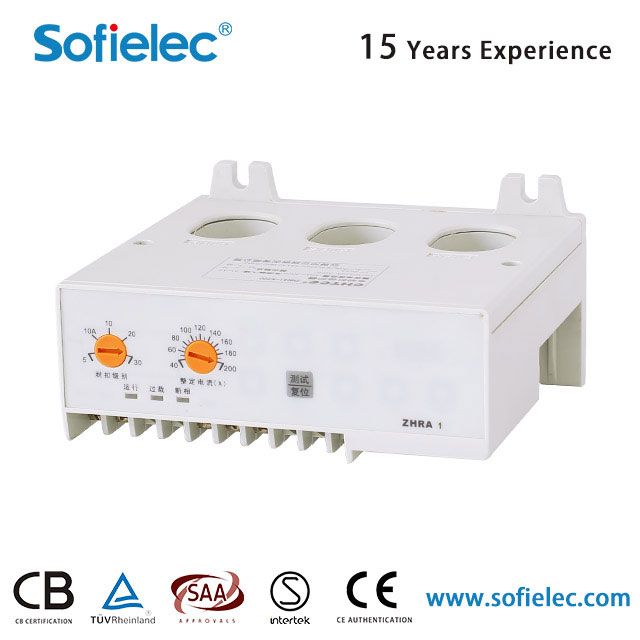
A motor protector relay that trips repeatedly is not just an inconvenience — it's a signal that something is wrong with the motor, the power supply, or the relay itself. The Sofielec ZHRA1 is a microprocessor‑based motor protector relay that monitors current with ≤2% accuracy and protects against phase failure, overload, unbalance, and stall. But even the best relay can't distinguish between a genuine fault and a setup error. This guide breaks down the most common causes of overload relay tripping — and how to prevent them.
When the motor is genuinely working too hard
When a motor is genuinely overloaded, the relay is doing its job. The trick is confirming that it's a real overload and not something else.
What you'll hear and see before it trips
Before the relay trips, the motor often gives clear warning signs. The motor sounds strained or "labored." The housing feels hotter than usual. The current draw on the ammeter exceeds the motor's full‑load amperage (FLA) rating. If you catch it early, you can often prevent the trip.
The hand‑spin test tells you a lot
Disconnect the motor from its load and try to rotate the shaft by hand. If it's stiff or doesn't rotate freely, the problem is mechanical — a seized bearing, a stuck pump impeller, or an over‑tightened belt. If the shaft turns freely, the overload may be electrical or the relay setting may be incorrect.
Catch it before the relay does
Regular lubrication of bearings, belt tension checks, and a baseline current log are your best defenses. Record the current draw when the motor is running under normal conditions. If that number creeps up over time, you'll catch the problem before the relay does.
When one phase goes missing
Three‑phase motors rely on all three phases being present and balanced. When one phase drops out, the motor tries to run on two phases, drawing excessive current and tripping the relay.
One phase reads zero — that's the clue
On a three‑phase system, one phase current reads zero or significantly lower than the others. The motor may hum loudly, run roughly, or trip the overload relay within seconds. In some cases, the motor may not start at all — it just sits and hums until the relay trips.
Blown fuse, burned contact, loose terminal
A blown fuse on one phase, a burned or pitted contactor contact, or a loose terminal connection. Over time, vibration loosens connections, and contactor contacts pit from arcing.
A relay that watches for phase loss
Use a motor protector relay with built‑in phase failure protection. The ZHRA1 detects phase loss and unbalance and shuts down the motor before damage occurs. Monthly contactor inspections and thermal imaging of terminal blocks can catch loose connections before they become failures.
When the relay doesn't match the motor
This is one of the most common — and most preventable — causes of nuisance tripping. The relay is set for a different motor than the one it's actually protecting.
Trips even when the motor isn't working hard
The motor runs at or below its rated current, but the relay trips anyway. Or, the motor is clearly overloaded but the relay doesn't trip — meaning the setting is too high. Both are signs that the relay isn't matched to the motor.
FLA × service factor — get the math right
The relay should be set to the motor's full‑load amperage (FLA) multiplied by the service factor — typically 1.0 to 1.15 for most motors. For example, a 10A motor with a 1.15 service factor should be set to 11.5A. The ZHRA1 uses a knob‑set current adjustment with ≤5% accuracy, making it easier to get the setting right.
Set it once, check it when you change motors
When you replace a motor, always re‑set the relay. Don't assume the old setting is still correct. Electronic relays like the ZHRA1 eliminate the need to match heater elements — you simply dial in the correct current value.
When the relay gets cooked by its own cabinet
Thermal overload relays use a bimetallic strip that bends when heated. If the air around the relay is already hot, the strip can bend and trip the relay even when the motor current is normal.
Trips on hot days, fine on cold days
The relay trips more often on hot days or when the control cabinet is closed. In winter, the problem disappears. The motor current reads normal, but the relay trips anyway.
40°C is the limit — beyond that, the relay drifts
Thermal relays are calibrated at 40°C. If the ambient temperature exceeds that, the effective trip threshold drops. A relay set to trip at 10A may trip at 8A if the cabinet is at 50°C. The ZHRA1, with its microprocessor‑based design, is less affected by ambient temperature than a traditional bimetallic relay.
Move it, vent it, or go electronic
Install the relay in a cooler part of the panel or add cabinet ventilation. For critical applications, specify an electronic relay with a wide operating temperature range. The ZHRA1 operates in ambient temperatures up to 40°C at ≤50% relative humidity.
When the motor starts too many times
Motor starting current is typically six to eight times the full‑load current. Frequent starts cause heat to build up in the motor and the relay faster than it can dissipate.
Each start trips faster than the last
The relay trips faster with each subsequent start. A motor that runs for 30 minutes on the first start might only run for 10 minutes on the fifth. The heat accumulation is the problem — not a single overload event.
10 starts per hour is the red line
For standard induction motors, more than 10 starts per hour is considered frequent. Jogging — repeatedly starting and stopping in quick succession — is even harder on the motor and the relay.
Soft start, VFD, or a higher trip class
Consider a soft starter or variable frequency drive for applications that require frequent starts. If that's not an option, select a relay with a higher trip class. The ZHRA1 offers four optional trip classes, allowing you to match the relay's response to the motor's thermal characteristics.
Match the symptom to the cause — fast
| Symptom | Likely Cause | Immediate Check |
|---|---|---|
| Trips only after running 30+ minutes | True overload or high ambient | Measure current, check mechanical load |
| Trips instantly on start | Phase loss or short circuit | Check supply voltage on all three phases |
| Trips randomly with no pattern | Loose connection or vibration | Tighten terminals, inspect relay mounting |
| Trips less often in winter | Ambient temperature effect | Replace with electronic type |
| Trips faster on each restart | Frequent starting (heat accumulation) | Reduce starts/hr or choose higher trip class |
What maintenance teams actually ask
Q: Won't reset? Let it cool — or replace it
A: Wait a few minutes for the bimetallic strip to cool. If it still won't reset, the internal contacts may have welded shut — a sign that the relay has experienced a severe fault and needs replacement. Electronic relays like the ZHRA1 don't have this problem; they can be reset immediately after the fault is cleared.
Q: Dry pump = less current — overload won't see it
A: Not with a standard overload relay. A dry‑running pump actually draws less current, so an overload relay won't detect it. You need a separate dry‑run protection device — a current‑based underload relay, a level switch, or a pressure sensor.
Q: Class 10, 20, 30 — which one do you need?
A: These classes define how quickly the relay trips at 7.2 times the rated current. Class 10 trips in 10 seconds, Class 20 in 20 seconds, and Class 30 in 30 seconds. Higher classes are for high‑inertia loads — fans, centrifuges, and flywheels — that take longer to start. The ZHRA1 offers all four classes, allowing you to match the relay to your motor's starting characteristics.
Stop fixing, start preventing
One tripped relay is a repair. Repeated tripped relays are a pattern — and patterns need a systematic response.
Quarterly thermal imaging. Scan all connections in the motor control circuit. A hot terminal is a loose terminal.
Log every trip. If your relay has diagnostic capabilities — the ZHRA1 uses LED indicators to show operating status — record the fault type and the current reading at the time of the trip. Over time, this log becomes a predictive tool.
Replace aging thermal relays. Bimetallic strips fatigue over time. After 3–5 years of service, or 5,000 operating hours, replace them proactively.
The Sofielec ZHRA1 motor protector relay is designed for air conditioning units, elevator machine rooms, pumps, fans, and other motor control applications. Its microprocessor‑based design, current measurement accuracy of ≤2%, and four optional trip classes make it a versatile upgrade for facilities looking to reduce nuisance tripping and extend motor life.
Before you replace a motor that keeps tripping its overload relay, check the relay itself. The problem might be the setting, the environment, or a simple loose connection — not the motor.
Need help selecting the right motor protector relay for your application? Contact Sofielec for a selection guide or product consultation. Share your motor FLA, starting duty, and environmental conditions — their team can recommend the right ZHRA1 configuration for your specific needs.