English
 Español
Why Does Your Electrical System Need a Residual Current Circuit Breaker?
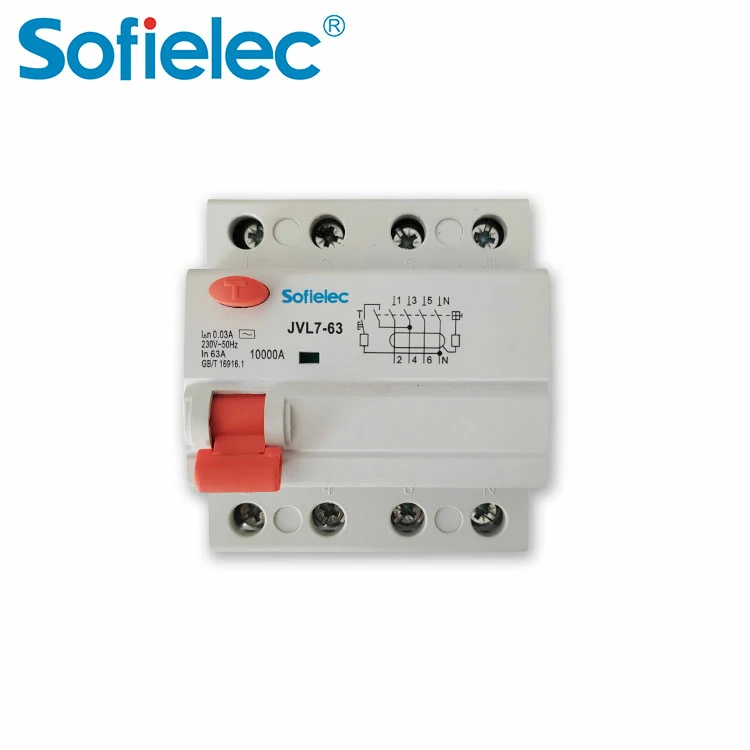
You're designing an electrical distribution system for a commercial building, an industrial facility, or a residential complex. The wiring is correct, the breakers are sized properly, and the connections are secure. But there's still a hidden risk: leakage current. A residual current circuit breaker RCCB is the device that addresses this risk directly. Unlike standard circuit breakers that protect against overloads and short circuits, an RCCB continuously monitors the current flowing through the live and neutral conductors. The moment it detects an imbalance—current leaking to earth through a fault or a person—it trips instantly, cutting off the power before harm can occur. The JVL7-63 is a compact, electromagnetic RCCB designed for 240/415V AC systems at 50/60Hz, available in 1P+N and 3P+N pole configurations with residual operating currents from 30mA to 300mA. This guide covers what makes an RCCB essential for electrical safety, the key specifications to check, and how to select the right one for your application.
What an RCCB Does – And Why Standard Breakers Can't
A standard miniature circuit breaker (MCB) protects against overcurrent—too much current flowing through the circuit due to an overload or short circuit. It doesn't detect leakage current. An RCCB, by contrast, is a dedicated earth leakage protection device. It measures the vector sum of currents flowing through the live and neutral conductors. In a healthy circuit, these currents are equal and opposite, summing to zero. When a leakage current flows to earth—through a person touching a live part, through damaged insulation, or through moisture—the sum becomes non-zero. The RCCB detects this imbalance and trips, typically within milliseconds.
Leakage Current vs. Overcurrent – Two Different Threats
Leakage current and overcurrent are fundamentally different failure modes. Overcurrent is predictable and gradual; leakage current can be instantaneous and deadly. An MCB protects equipment; an RCCB protects people. The JVL7-63 is designed for precisely this purpose: protecting the power system and equipment from electric leakage.
The Electromagnetic Advantage
The JVL7-63 is an electromagnetic type RCCB. Unlike electronic RCCBs that require an external power supply to operate, electromagnetic RCCBs are self-powered—they derive their operating energy from the fault current itself. This means they continue to function even if the neutral is lost or the supply voltage is unstable.
Sensitivity That Matches the Risk – Choosing the Right Residual Current
The JVL7-63 offers rated residual operating currents (I△n) of 0.03A (30mA), 0.1A (100mA), and 0.3A (300mA). The choice of sensitivity depends on the application and the level of protection required.
30mA – The Standard for Personnel Protection
30mA is the standard residual operating current for personnel protection in most residential and commercial applications. At this sensitivity, the RCCB trips when a leakage current of 30mA or more is detected—well below the threshold for ventricular fibrillation in humans.
100mA and 300mA – Equipment and Fire Protection
Higher residual operating currents are used where the risk is primarily to equipment or where nuisance tripping must be avoided. 100mA and 300mA RCCBs are commonly used in industrial applications, where leakage currents from motors and heaters can be higher than 30mA during normal operation. They also provide protection against fire risk caused by ground faults.
Type A and Type S – Matching the RCCB to the Load
The JVL7-63 offers Type A and Type S residual operating current characteristics. Type A RCCBs detect both AC residual currents and pulsating DC residual currents, making them suitable for circuits with electronic loads. Type S RCCBs are time-delayed, providing selectivity in multi-level installations.
Pole Configurations – 1P+N and 3P+N
The JVL7-63 is available in 1P+N and 3P+N pole configurations, with N on the left and N on the right.
1P+N – For Single-Phase Circuits
1P+N RCCBs protect single-phase circuits, with one pole for the live conductor and one for the neutral. The neutral is switched, ensuring complete isolation when the RCCB trips. This configuration is standard for residential and light commercial applications.
3P+N – For Three-Phase Circuits
3P+N RCCBs protect three-phase circuits, with three poles for the live conductors and one for the neutral. They are used in industrial and commercial installations where three-phase loads are present.
Rated Current and Breaking Capacity – Matching the RCCB to the Circuit
The JVL7-63 is available with rated currents of 25A, 32A, 40A, and 63A. The rated breaking capacity is 6000A.
Selecting the Right Rated Current
The rated current of the RCCB must be equal to or greater than the maximum continuous current of the circuit it protects. A 63A RCCB is suitable for circuits with loads up to 63A; a 25A RCCB is suitable for smaller circuits. The RCCB is designed for circuits with a rated voltage of 240/415V AC at 50/60Hz.
Breaking Capacity – What 6000A Means
The 6000A breaking capacity means the RCCB can safely interrupt a fault current of up to 6,000A without being damaged. This is the standard breaking capacity for most residential and light commercial RCCBs, sufficient for the majority of installations where the prospective short-circuit current is below 6kA.
Key Specifications
| Specification | JVL7-63 Value | Why It Matters |
|---|---|---|
| Executive standards | IEC61008, GB/T16916.1 | International compliance |
| Type | Electromagnetic | Self-powered, reliable |
| Residual operating current characteristics | A, AC, S | Suitable for different load types |
| Number of poles | 1P+N, 3P+N (N left/right) | Flexible for single/three-phase |
| Rated current | 25, 32, 40, 63A | Matches circuit load |
| Rated voltage | AC240/415V | Single and three-phase systems |
| Rated residual operating current | 0.03, 0.1, 0.3A | Personnel or equipment protection |
| Rated breaking capacity | 6000A | Fault current interrupt capability |
| Mechanical/electrical life | 4000 operations | Long-term durability |
| Terminal capacity | 25mm² wire | Accommodates standard wiring |
| Mounting | 35mm DIN rail | Standard panel installation |
| Protection rating | IP20 | Indoor installation |
What Electrical Engineers Ask About RCCBs
What is the difference between an RCCB and an MCB?
An MCB protects against overcurrent (overload and short circuit). An RCCB protects against earth leakage (current flowing to earth through a fault or a person). The JVL7-63 is a dedicated RCCB without overcurrent protection. For combined protection, an RCBO integrates both functions in a single device.
What is the difference between Type A and Type AC RCCBs?
Type AC RCCBs detect only AC residual currents. Type A RCCBs detect both AC residual currents and pulsating DC residual currents, making them suitable for circuits with electronic loads—computers, VFDs, LED lighting, and EV chargers.
How do I choose between 30mA and 100mA sensitivity?
Choose 30mA for personnel protection in residential, commercial, and wet-area applications. Choose 100mA or 300mA for equipment protection or where nuisance tripping from normal leakage currents is a concern.
What is the maximum wire size the JVL7-63 can accept?
The terminals accept wires up to 25mm² cross-sectional area.
Is the JVL7-63 suitable for use as a main switch?
Yes. The RCCB provides isolation and can function as a main switch in distribution boards.
Need an RCCB That Delivers Reliable Leakage Protection? Let's Find the Right Fit
Selecting an RCCB comes down to three factors: residual current sensitivity (match your protection requirement), pole configuration (match your system), and rated current (match your circuit load). Contact Sofielec for a customized quote → —their team can help you select the right JVL7-63 configuration for your specific electrical protection needs.
Sofielec is a professional supplier of low-voltage circuit protection products with more than 15 years of global supply experience. The JVL7-63 Electric Leakage Circuit Breaker Without Overcurrent Protection is an electromagnetic RCCB compliant with IEC61008 and GB/T16916.1. It is available in 1P+N and 3P+N configurations with rated currents of 25A, 32A, 40A, and 63A, rated voltages of AC240/415V, and residual operating currents of 30mA, 100mA, and 300mA. The breaker offers a 6000A breaking capacity, 4000 mechanical and electrical operations, and 35mm DIN rail mounting. Applications include residential distribution, commercial buildings, industrial facilities, and temporary power installations where earth leakage protection is required. Connect with Sofielec to discuss your protection requirements, sensitivity needs, and pole configuration preferences.