English
 Español
What Is a Shunt Trip and How Does It Work with MCCB?
You’re designing a control panel for a production line and the safety specification requires an emergency stop that kills power to the whole machine — not just the controls, but the main incoming supply. Or maybe you’re wiring a fire suppression system in a data center, and the code says non-essential power must be cut before gas discharge. You could tell someone to run to the panel and flip the handle manually, but that’s slow, it requires a person at the right place at the right time, and it defeats the purpose of automated safety systems.
A shunt trip solves this problem. It’s a small electromagnetic coil that mounts inside a molded case circuit breaker or certain miniature breakers. When you apply voltage to it from a remote button, a PLC output, or a fire alarm panel, the coil fires a plunger into the breaker’s trip mechanism, opening the contacts instantly — no human needed. This guide walks through the working principle, real-world applications, voltage selection, wiring, and the field questions panel builders ask most often.
One coil, one shot – the simple principle behind remote tripping
The name “shunt trip” comes from the way the coil is connected: it shunts (branches off) the main current path, taking a separate control voltage source to operate independently of the line current.
How the solenoid physically trips the breaker
Inside a plastic housing is a solenoid — a coil of wire wrapped around a movable iron core. When you apply the right voltage, the coil energizes, creating a magnetic field that pulls the core forward. That core strikes a lever inside the breaker, releasing the latch that holds the contacts closed. The main springs snap the contacts open, and the circuit is dead.
Why the coil must not stay energized
The coil is not designed to stay energized. It’s a momentary‑duty solenoid, meaning it only needs power for an instant — typically 50–200 milliseconds — to complete its mechanical stroke. Once the breaker trips, the coil’s job is done. Standard short‑time ratings from industry sources specify that shunt trip coil energization should generally be limited to 1 second or less; sustained voltage will overheat the coil and destroy it.
To prevent accidental burnout, most shunt trip designs incorporate a “cutoff” feature: an auxiliary contact mounted right next to the coil. When the plunger reaches the end of its travel, that contact opens, cutting power to the coil even if the external control button is still pressed. This protects the coil while still allowing a simple maintained‑contact pushbutton (like an emergency stop) to trigger the trip. After the breaker trips, you have to physically reset the breaker handle — the shunt trip cannot reclose the contacts, only open them.
Below is a comparison of shunt trip vs. undervoltage release, two common breaker accessories that are frequently confused:
| Feature | Shunt Trip | Undervoltage Release |
|---|---|---|
| Trigger condition | External voltage applied (pulse signal) | Supply voltage drops below threshold (35–70% of rated) |
| Action | Opens breaker when energized | Opens breaker when voltage falls |
| Typical use | Emergency stop, remote shutdown, fire interlock | Safety interlock requiring presence of control voltage |
| Voltage source | Separate control circuit (24V DC, 110–230V AC) | Same as line side or separate power supply |
| Coil duty cycle | Momentary (≤1s) | Continuous |
| Reset after trip | Manual handle reset | Manual reset after voltage is restored |
Where you’ll find shunt trips in real B2B environments
Shunt trips appear in three common industrial and commercial applications. Each uses the same core principle but serves a different safety or operational need.
Emergency stop (E-stop) circuits
In factories and processing plants, safety codes often require that an E‑stop pushbutton disconnect all hazardous energy sources — including the main electrical supply to an entire machine cell. Hitting the mushroom‑head red button energizes the shunt trip coil, the breaker opens, and the whole station goes dead in milliseconds. NFPA 79 (industrial machinery) explicitly allows shunt trip breakers as a means of supply disconnection when configured for emergency stop functions.
Fire suppression system interlock
When a gas‑based fire suppression system (FM‑200, Novec 1230, CO₂) is about to discharge, building codes require that non‑essential electrical loads be shut down first to prevent re‑ignition and avoid pressurizing the fire area. The fire alarm control panel (FACP) sends a DC 24V signal to shunt trip coils on breakers feeding HVAC fans, lighting circuits, and other non‑critical equipment. Those breakers trip, the gas releases safely, and only essential safety circuits remain energized.
Remote shutdown from a control room
In utility plants, data centers, and marine vessels, an operator at a central console can kill power to a specific breaker located hundreds of meters away — no need to walk through a hazardous area to pull a handle. This capability is often required for arc flash safety: if a fault is detected by arc‑flash detection sensors, the system can trip the upstream breaker remotely before the fault escalates, reducing incident energy exposure.
Picking the right shunt trip — voltage and compatibility
Not every breaker can take a shunt trip, and not every shunt trip works with every breaker. Three specifications matter most.
Voltage matching – the non‑negotiable rule
Shunt trips are available in standard control voltages: DC 12V, 24V, 48V, and 110V, as well as AC 110V, 230V, and 400V. Your control system’s output — from a PLC, a dry‑contact relay, or an E‑stop pushbutton — must match the coil’s rated voltage exactly. The operating voltage range is typically 70–110% of the rated voltage. Apply lower than 70%, and the coil may not produce enough force to trip reliably. Apply higher than 110% (for sustained time) and you risk overheating.
Duty cycle – keep it momentary
Shunt trip coils are rated for momentary duty only. A common specification is energization time ≤200ms. If your control circuit could apply voltage for longer — for instance, using a pushbutton that latches closed until manually reset — you must incorporate a cutoff contact or a timing relay to remove power after the trip occurs. Some breakers include an internal “a” auxiliary contact specifically for this purpose. Wire that auxiliary contact in series with the coil; as soon as the breaker opens, the contact opens, de‑energizing the coil regardless of the external signal.
Frame size and brand compatibility
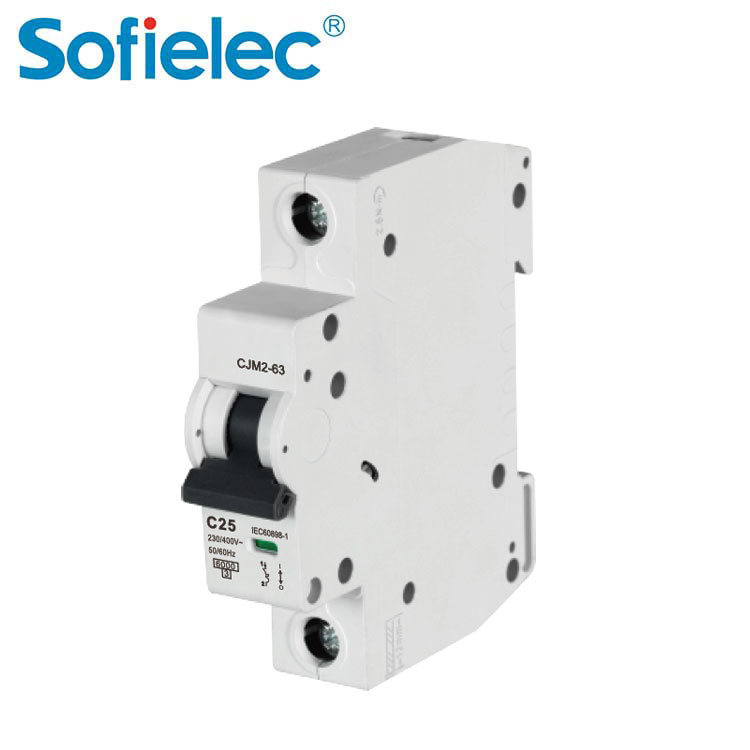
A shunt trip designed for a 63A frame breaker will physically fit into a 250A breaker of the same series, but it may not have enough mechanical force to trip the larger mechanism. Always match the shunt trip to the specific breaker frame size and series. For Sofielec’s CJM2‑63 MCB series (1P, 2P, 3P, 4P, up to 63A), accessories including shunt release, overvoltage/undervoltage release, and auxiliary contacts are available as field‑assemblable add‑ons. The breaker is rated at 6kA short‑circuit capacity (IEC60898), suitable for residential and light industrial distribution.
How the wiring goes together — a simple circuit description
You don’t need a complex schematic to understand the basic shunt trip control circuit. The coil has two terminals (often labeled A1 and A2, or C1 and C2). One side connects to the neutral or DC common. The other side connects through the control contacts to the line/hot side of the supply.
Single pushbutton emergency stop wiring
Supply live (L) → emergency stop pushbutton (normally open contact) → shunt trip coil A1. Coil A2 → neutral. The pushbutton must be a maintained‑contact type (twist‑to‑reset). When you press it, the circuit closes, the coil energizes, and the breaker trips. Almost immediately, the breaker’s auxiliary contact (wired in series with the coil) opens, cutting power to the coil even though the pushbutton is still depressed. This protects the coil from burnout.
Multiple remote stations and PLC control
For multiple trip stations — for example, killing a conveyor from either end of a long line — wire the pushbuttons in parallel. Any button closed completes the circuit and trips the breaker.
If the trip signal comes from a fire alarm panel or PLC output, treat the output relay as a pushbutton. Connect the relay contacts across the shunt trip coil, and set the PLC output as a momentary pulse (e.g., 200ms duration). This is the cleanest way to drive a shunt trip because the PLC itself provides the cutoff timing, eliminating reliance on the auxiliary contact. A common mistake is using a maintained PLC output (a bit that stays true until manually cleared). In that case, the breaker trips, but the coil remains energized until someone resets the PLC output — unless the internal cutoff contact is properly wired, this will overheat and destroy the coil.
Installation checks before you power up
Installing a shunt trip is not complicated, but skipping any of these checks is the fastest way to get a callback or a burned coil.
-
Confirm voltage with a meter. Measure the control voltage at the breaker panel end, not at the source. Control voltage can drop over long runs; a nominal 24V DC might be 20V at the breaker, below the 70% threshold. If too low, upsize wiring or move the control supply closer.
-
Test trip before energizing loads. After installation but before connecting main load cables, apply the trip signal. Listen for the “clack” of the mechanism. Verify the breaker handle moves to the tripped position (midpoint between ON and OFF). Reset to OFF then ON. Repeat at least twice.
-
Verify cutoff works. Monitor the shunt trip coil terminals with a multimeter while applying the trip signal. Voltage should appear for less than 200ms and then disappear, even if the trip signal remains present. If voltage stays longer, the auxiliary cutoff contact is miswired or failed.
-
Add clear labeling. Mark the breaker cover: “SHUNT TRIP — REMOTE TRIPPING DEVICE INSTALLED.” Future workers need to know the breaker can be tripped remotely.
-
Document the trip signal source. Note in panel drawings which PLC output, E‑stop station, or FACP provides the shunt trip signal. This saves hours of tracing later.
Questions panel builders and engineers ask most
Q: Can a shunt trip be added to an existing breaker in the field?
A: Only if the breaker model has a factory‑provisioned accessory slot. Check the manufacturer’s datasheet. Some breakers have a covered pocket on the left or right side that accepts field‑installed accessories. Others require factory installation. For breakers without an accessory slot, you must replace the entire breaker with a model that includes the shunt trip or has the slot available. Sofielec’s CJM2‑63 MCB series lists “assemblable accessories: shunt release, overvoltage/undervoltage release, auxiliary contact” as a feature, indicating field retrofit is supported.
Q: What happens if I keep voltage on the shunt trip coil for a long time?
A: The coil overheats and fails — often in seconds, not minutes. Shunt trip coils are designed for momentary duty only, typically ≤1 second. If the coil remains energized beyond that, the magnet wire insulation melts, the coil shorts, and the part must be replaced. That’s why standard practice uses either a momentary trip signal (pulse from a PLC) or a cutoff contact wired in series with the coil.
Q: Can I use a shunt trip on a miniature circuit breaker (MCB), or only on MCCBs?
A: Yes, many MCB families offer shunt trip accessories. However, the accessory must be specifically designed for that MCB series — they are not interchangeable across brands or even across different frame sizes from the same manufacturer. Sofielec’s JVM7‑63 and JVM8‑63 series both support shunt release accessories. That said, shunt trips are far more common on MCCBs because MCCBs are used as main disconnects and feeder breakers where remote tripping is most often required. MCBs are typically used on branch circuits; remote tripping on MCBs appears more often in commercial building fire alarm shutdown applications than in industrial control panels.
Q: What’s the difference between shunt trip and undervoltage release?
A: A shunt trip requires voltage to be applied to cause tripping — you apply power, the breaker opens. An undervoltage release requires voltage to keep the breaker closed; if that voltage drops below a threshold (typically 35–70% of rated), the breaker trips. Undervoltage releases are used for safety interlocks: e.g., a machine that must not restart after a power outage, or a circuit that must de‑energize if its control power fails. The two devices look similar and mount in the same accessory slots, but they are not interchangeable. Never substitute one for the other without checking the circuit design.
How Sofielec’s CJM2‑63 MCB supports shunt trip installation
Sofielec’s CJM2‑63-1 1P 2P 3P 4P mini circuit breaker MCB is designed for residential and light industrial distribution, rated up to 63A at 230/400V AC with a short‑circuit capacity of 6kA (IEC60898). The breaker carries IEC CB, SEMKO, CE, and KEMA certifications, making it suitable for export and compliance‑sensitive projects.
Critically for this application, the CJM2‑63 series supports field‑assemblable accessories, including a shunt release (shunt trip), overvoltage/undervoltage release, and auxiliary contact. The accessory module fits into a side pocket on the breaker without special tools. Installation follows the standard process: power off, remove the breaker cover, insert the shunt trip module until it clicks, route the leads through the knockout, and reassemble. After installation, follow the functional test steps described above.
For panel builders who need remote trip capability on branch circuits — or who want to add E‑stop or fire interlock functionality to existing distribution boards — the CJM2‑63 with shunt release offers a compact, cost‑effective solution. Always verify that the shunt trip part number matches your exact breaker pole configuration (1P, 2P, 3P, or 4P) and rated current, as internal trip mechanisms may differ across frame sizes.
Before ordering in quantity, request a sample shunt trip accessory and test it with your specific breaker and control voltage. A few minutes of validation now prevents field failures later.
Need to specify a shunt trip for your next control panel or retrofit project? Contact Sofielec with your breaker model (CJM2‑63 or other), frame size, required control voltage (AC/DC), and application type (E‑stop, fire interlock, or remote shutdown). Their technical team can confirm compatibility, provide accessory part numbers, and send installation instructions.