English
 Español
Guide to Selecting a Surge Protective Device (SPD) for EV Charging Stations
A commercial EV charging station is hit by a nearby lightning strike. The AC input protection holds, but three chargers display fault codes. The touchscreens are unresponsive, and the communication modules are offline. Weeks of troubleshooting point to a single cause: inadequate surge protection. EV chargers contain power electronics, control boards, metering, and communications hardware—all sensitive to voltage spikes from lightning, utility switching, and load switching events. Choosing an SPD Surge Protective Device without understanding voltage domains, discharge ratings, and coordination leaves your investment exposed. This guide walks you through selecting SPDs for AC Level 2 pedestals and DC fast chargers, explains the parameters that actually matter in the field, and gives you decision rules that work across sites—whether you‘re retrofitting a parking garage or building a new charging hub.
AC and DC sides need different rules
Every EV charging site has two electrical worlds. The AC side brings power from the utility—208V or 480V three‑phase. This is where building‑level protection starts. The DC side exists inside fast chargers, converting AC to DC at voltages up to 1000V for the vehicle battery. An SPD that works on the AC side will fail—catastrophically—on the DC side. DC arcs do not self‑extinguish, so DC SPDs require different arc‑quenching chambers and varistor characteristics. Never substitute.
AC side – standard LV distribution
For AC circuits feeding Level 2 chargers, use AC SPDs rated for 208V or 480V systems, depending on local supply. Type 2 SPDs are the most common choice for distribution boards feeding EV chargers, typically installed in main LV panels or sub‑distribution boards. For sites with outdoor overhead feeders or lightning rods at the building entrance, a Type 1 SPD at the main intake provides the first layer of defense.
DC side – dedicated protection for power electronics
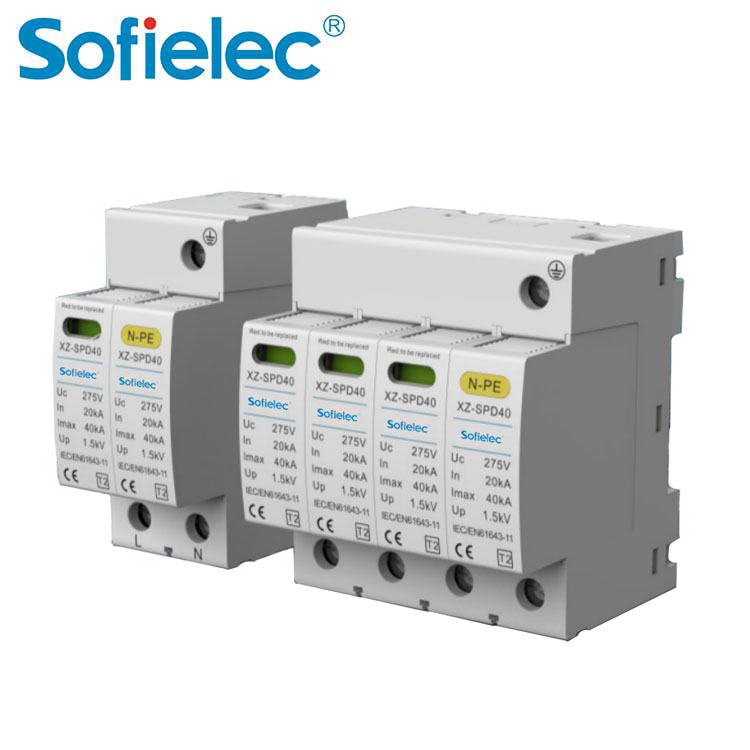
DC fast chargers (50kW–350kW) operate with bus voltages up to 1000V and soon 1500V. The DC converter and the connected vehicle both need protection. IEC 61851‑23 requires a voltage protection level (Up) of ≤2.5kV at the DC output. For DC circuits, use DC‑rated SPDs only—designed with DCD technology to safely interrupt DC switch arcs. The XZ‑SPD series from Sofielec includes models rated for AC low‑voltage distribution, while DC‑specific protection should be sourced from specialized DC SPD lines.
What the spec sheet numbers really mean
Spec sheets list many numbers, but only a few determine whether the SPD will actually protect your chargers. Nominal discharge current (In) and maximum discharge current (Imax). For commercial charging stations, select an SPD with In ≥20kA (8/20μs waveform) and Imax ≥40kA. Lower ratings may not survive multiple surge events. The XZ series from Sofielec offers models with In = 20kA and Imax = 40kA—suitable for Type 2 applications. Voltage protection level (Up). This is the voltage let through to your equipment during a surge. On the AC side, Up ≤1.5kV is sufficient for most charger power supplies. On the DC side, chargers operating at 1000V require Up ≤2.5kV to meet IEC 61851‑23. Short‑circuit withstand rating. If the charging station sits downstream of high available fault current, the SPD must be coordinated with upstream fuses or breakers. Check the manufacturer‘s specified SCCR or recommended backup protection. The XZ‑NPE 275V series is suitable for residential distribution boxes, computer centers, and control equipment, but for commercial charging stations, a higher‑energy model with Imax ≥40kA is recommended.
Three real charging scenarios – which SPD fits where
AC Level 2 pedestals (208/240V)
This is the most common configuration for parking garages, retail centers, and workplace charging. The main distribution board feeds several pedestals. Install a Type 2 SPD with 3+0 protection mode (three phases + neutral), In ≥20kA, Imax ≥40kA, and Up ≤1.5kV. Mount the SPD in the distribution board, as close as possible to the point where power lines enter. Sofielec’s XZ‑SPD series for low‑voltage AC power distribution (230/400V, 50/60Hz) is suitable for this application. For a single pedestal fed by a dedicated branch circuit, a Type 2 SPD installed at the pedestal’s local disconnect provides additional protection.
DC fast chargers (50kW–150kW, up to 800V DC bus)
DC fast chargers require a layered protection strategy. On the AC input side, install a Type 1 or Type 2 SPD at the main panel feeding the charger power module. On the DC side—between the charger output and the vehicle cable—install a DC‑rated SPD (1000V DC, In ≥20kA, Imax ≥40kA) with Up ≤2.5kV. The SPD must be placed as close as possible to the handover point between the charger and the vehicle. DC‑specific SPDs are designed for the higher electrical load from continuous operating voltage and transient overvoltages defined in IEC 61851‑23.
Retrofitting older stations
Existing stations often lack SPDs or have undersized units. Start with a site survey: verify the type of SPD present (if any), its location (main panel vs. local disconnect), and its current ratings. Check the visual status indicator; if the window is red, the MOV has degraded and the SPD must be replaced immediately. For retrofits, ensure the enclosure has enough DIN rail space for the new SPD module. Add external disconnect means if required by local code. For long feeder runs (over 30 meters) from the distribution board to the charger, install an additional Type 2 SPD at the charger disconnect to prevent reflected wave surges. Keep SPD connection leads short—total length per conductor should not exceed 0.5 meters.
Small installation details that make a big difference
An SPD‘s performance depends more on installation quality than on its specification. Keep leads short. Each connection conductor (line to SPD, SPD to ground) should be as short as possible—total length per conductor under 0.5 m. Long leads introduce inductance that reduces clamping effectiveness. Use twisted pairs. Twist the line and neutral conductors together to reduce the inductive loop area. Provide upstream overcurrent protection. Install a circuit breaker or fuse (typically 32A for a 40kA SPD) ahead of the SPD. This protects against thermal runaway if the MOV fails shorted. Record the SPD’s life count. Many units include remote signaling contacts or a mechanical operation counter. Monitor these to know when the MOV has degraded. Label the panel. Mark the SPD location and the date of last replacement inside the distribution board for future maintenance. The XZ series SPD from Sofielec is designed for DIN rail mounting, making retrofits and new installations straightforward for qualified electricians.
Common questions from EV charger installers
Q: Do I need an SPD for every EV charging pedestal? A: If multiple chargers share a common distribution board, one adequately sized SPD at the board provides sufficient protection for the group. For long feeder runs (exceeding 30 meters) or for chargers in separate buildings, install additional SPDs at each charger‘s local disconnect.
Q: What’s the difference between Type 1, Type 2, and Type 3 SPD? A: Type 1 is rated for direct lightning current (10/350μs waveform) and is installed at the service entrance where lightning may hit overhead lines. Type 2 handles induced surges (8/20μs) and is installed in distribution boards feeding chargers. Type 3 is for point‑of‑use fine protection, placed immediately adjacent to sensitive equipment. For most commercial AC charging stations, Type 2 is sufficient. For sites with external lightning protection systems or overhead feeders, add a Type 1 at the main intake.
Q: Can I use an AC SPD on the DC side of a fast charger? A: Absolutely not. AC SPDs are not designed for DC arc extinction. The varistor in an AC SPD may not reset after a DC surge, leading to sustained conduction, overheating, and fire. Use only SPDs explicitly rated for DC, with appropriate DC voltage rating (e.g., 1000V DC).
Q: How often should I replace SPDs at charging stations? A: Replace an SPD immediately if its visual status indicator shows red (end‑of‑life). Even without a red indication, SPDs degrade over time. Typical service life is 5–10 years, or after approximately 20 nominal discharge events. After any major lightning storm within 500 meters of the site, inspect the SPD indicator and consider replacement if the unit has operated multiple times.
How much surge protection your site actually needs
Site lightning exposure determines how much protection you need. For low risk (fewer than 15 thunderstorm days per year), a Type 2 SPD with In=10kA may be sufficient, though commercial stations benefit from higher margins. For medium risk, select Type 2 with In ≥20kA, Imax ≥40kA, and Up ≤1.5kV. For high risk or isolated buildings with overhead feeders, use layered protection: a Type 1+2 SPD (or Type 1 at service entrance plus Type 2 at distribution boards) with In ≥20kA for Type 2 sections. Always record the SPD model, installation date, and replacement log in the site maintenance file. Sofielec‘s XZ‑SPD series includes models rated for AC low‑voltage power distribution in TN, TT, IT earthing systems, suitable for many commercial charging applications. For DC fast charger protection, consult DC‑specific product lines that meet IEC 61643‑41.
→ Request a quote from Sofielec for the XZ‑NPE 275V Surge Protector 20KA/40KA — Share your charging station configuration (AC Level 2 or DC fast charger), system voltage, and expected lightning exposure. Their technical team can recommend the right SPD type and rating for your site.